

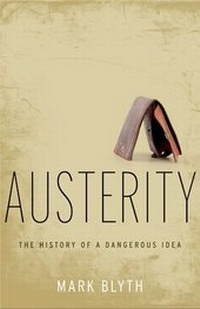
Austerity
The History of a Dangerous Idea
1st Edition
Published on 25. April 2013
Book
Hardback
304 pages
978-0-19-982830-2 (ISBN)
Description
Conservatives in America have succeeded in casting government spending as useless profligacy that has made their economy worse, centering the policy debate in the wake of the financial crisis on draconian budget cuts. Americans are told that they need to live in an age of austerity since they have all lived beyond their means and now need to tighten their belts. This view conveniently forgets where all that debt came from. Not from an orgy of government spending, but as the direct result of bailing out, recapitalizing, and adding liquidity to the broken banking system. Through these actions private debt was rechristened as government debt while those responsible for generating it walked away scot free, placing the blame on the state, and the burden on the taxpayer. That burden now takes the form of a global turn to austerity, the policy of reducing domestic wages and prices to restore competitiveness and balance the budget. The problem, according to political economist Mark Blyth, is that austerity is a very dangerous idea. First of all, it doesn't work.
As the past two years of trying and countless other historical examples show, while it makes sense for any one state to try and cut its way to growth, it simply cannot work when all states try it simultaneously: all that happens is a shrinking economy. Second, it relies upon those who didn't make the mess to clean it up, which is always bad politics. Third, it rests upon a tenuous and thin body of evidence and argumentation that acts more to prop up dead economic ideas and preserve astonishingly skewed income and wealth distributions than to restore prosperity for all. In Austerity: The History of a Dangerous Idea, Blyth demolishes the conventional wisdom, marshaling an army of facts to demand that we recognize austerity for what it is, and what it costs us.
As the past two years of trying and countless other historical examples show, while it makes sense for any one state to try and cut its way to growth, it simply cannot work when all states try it simultaneously: all that happens is a shrinking economy. Second, it relies upon those who didn't make the mess to clean it up, which is always bad politics. Third, it rests upon a tenuous and thin body of evidence and argumentation that acts more to prop up dead economic ideas and preserve astonishingly skewed income and wealth distributions than to restore prosperity for all. In Austerity: The History of a Dangerous Idea, Blyth demolishes the conventional wisdom, marshaling an army of facts to demand that we recognize austerity for what it is, and what it costs us.
Reviews / Votes
Blyths book is important and informative John M. Legge, Dissent Magazine Blyths analysis provides answers that are as much complex as they are comprehensive. Nevertheless, the book is not particularly hard reading, offering accessible political economy at its best even for non-economists. At times it is indeed polemically entertaining, and I highly recommend reading it. Andreas Botsch, Transfer [a] timely, authoritative account. Peter Geoghegan, Sunday Business Post [a] fascinating account ... among the best and most clear-sighted that I have read on the matter. The Crack [C]lear, simple, and occasionally humorous ... It's a pity the two Eds didn't read this book before they announced that 'we're all Austerians now.' Austin Mitchell, The House Magazine [A]n excellent new book by Mark Blyth The Guardian Blyth writes in the tradition of Keynes, slashing away at orthodoxy and the orthodox, emphasising the power of ideas as well as interests in shaping outcomes, ranging widely over the history of economic and political thought, expressing deep scepticism about financial actors, and rejecting the curtailment of spending as the solution to a period of excess. Lawrence Summers, Financial Times Austerity: The History of Dangerous Ideas is a masterful combination of economic history and intellectual history that puts the current policy debate into a balanced and sophisticated perspective. Anyone who wants to understand what is going on in the world at the moment should read it. Right away. Ha-Joon Chang, Irish Times Austerity is an economic policy strategy, but is also an ideology and an approach to economic management freighted with politics. In this book Mark Blyth uncovers these successive strata. In doing so he wields his spade in a way that shows no patience for fools and foolishness. Barry Eichengreen, Professor of Economics and Political Science University of California, Berkeley, author of 'Exorbitant Privilege'More details
Language
English
Place of publication
New York
United States
Target group
College/higher education
Professional and scholarly
General readers interested in economics, international trade, and current political and economic policy trends.
Dimensions
Height: 217 mm
Width: 147 mm
Thickness: 25 mm
Weight
472 gr
ISBN-13
978-0-19-982830-2 (9780199828302)
Copyright in bibliographic data and cover images is held by Nielsen Book Services Limited or by the publishers or by their respective licensors: all rights reserved.
Schweitzer Classification
Other editions
Additional editions
Book
02/2015
Oxford University Press Inc
€18.50
Shipment within 15-20 days
E-Book
03/2013
1st Edition
OUP eBook
€7.49
Available for download
E-Book
03/2013
1st Edition
OUP eBook
€7.49
Available for download
Person
Mark Blyth is Professor of International Political Economy at Brown University. His books include Great Transformations: Economic Ideas and Institutional Change in the Twentieth Century.