

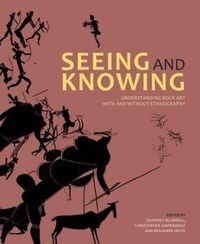
Seeing and Knowing
Rock Art with and Without Ethnography
Will be published approx. on 1. January 2010
Book
Paperback/Softback
328 pages
978-1-86814-513-3 (ISBN)
Description
The depth and wide geographical impact of David Lewis-Williams.
It is largely through the work of David Lewis-Williams that San rock art has come to be understood so well, as a complex symbolic and metaphoric representation of San religious beliefs and practices. The purpose of this volume is to demonstrate the depth and wide geographical impact of Lewis-Williams' contribution, with particular emphasis on the use of theory and methodology drawn from ethnography that he has used with inspirational effect in understanding the meaning and context of rock art in various parts of the world. Seeing and Knowing explores how to understand and learn from rock art with and without ethnography. Because many of the chapters are based on solid fieldwork and ethnographic research, they offer a new body of work that provides the evidence for differentiation between knowing and simply seeing. This volume is unique in that it focuses exclusively on rock art and ethnography, and covers such a wide geographic range of examples on this topic, from southern Africa, to Scandinavia, to the United States. Many of the chapters explore studies in rock art regions of the world where variation and constancy can be observed and explored across distances both in space and in time. The editors have entitled the book Seeing and Knowing to echo Lewis-Williams' Believing and Seeing published almost thirty years ago; they say 'seeing' again because looking at rock art is and will always be central, and then what is seen when human eyes and minds look; they say 'knowing' in recognition that, by his work and by his example, archaeologists now know a little more than they knew before. Even so, as Lewis-Williams will be the first to say, we still know only a fraction.
It is largely through the work of David Lewis-Williams that San rock art has come to be understood so well, as a complex symbolic and metaphoric representation of San religious beliefs and practices. The purpose of this volume is to demonstrate the depth and wide geographical impact of Lewis-Williams' contribution, with particular emphasis on the use of theory and methodology drawn from ethnography that he has used with inspirational effect in understanding the meaning and context of rock art in various parts of the world. Seeing and Knowing explores how to understand and learn from rock art with and without ethnography. Because many of the chapters are based on solid fieldwork and ethnographic research, they offer a new body of work that provides the evidence for differentiation between knowing and simply seeing. This volume is unique in that it focuses exclusively on rock art and ethnography, and covers such a wide geographic range of examples on this topic, from southern Africa, to Scandinavia, to the United States. Many of the chapters explore studies in rock art regions of the world where variation and constancy can be observed and explored across distances both in space and in time. The editors have entitled the book Seeing and Knowing to echo Lewis-Williams' Believing and Seeing published almost thirty years ago; they say 'seeing' again because looking at rock art is and will always be central, and then what is seen when human eyes and minds look; they say 'knowing' in recognition that, by his work and by his example, archaeologists now know a little more than they knew before. Even so, as Lewis-Williams will be the first to say, we still know only a fraction.
More details
Language
English
Place of publication
Johannesburg
South Africa
Target group
Professional and scholarly
Product notice
Paperback (trade)
Illustrations
120 black and white illustrations
Dimensions
Height: 244 mm
Width: 198 mm
Thickness: 18 mm
Weight
953 gr
ISBN-13
978-1-86814-513-3 (9781868145133)
Copyright in bibliographic data and cover images is held by Nielsen Book Services Limited or by the publishers or by their respective licensors: all rights reserved.
Schweitzer Classification
Other editions
Additional editions
E-Book
12/2010
Abingdon Press
€29.49
Available for download
Persons
Geoffrey Blundell is Head of the Department of Human Sciences at the KwaZulu-Natal Museum in Pietermaritzburg.
Christopher Chippindale is a Reader in Archaeology at the University of Cambridge and is Senior Curator at the Museum of Archaeology and Anthropology.
Jean Clottes is internationally renowned scholar and authority on rock art and is now retired.
Margaret W. Conkey is Professor Emerita in the Archaeological Research Facility and Department of Anthropology, University of California, Berkeley.
Edward B. Eastwood was Research Associate of the University of the Witwatersrand's Rock Art Research Institute until his death in 2008.
Christopher Chippindale is a Reader in Archaeology at the University of Cambridge and is Senior Curator at the Museum of Archaeology and Anthropology.
Jean Clottes is internationally renowned scholar and authority on rock art and is now retired.
Margaret W. Conkey is Professor Emerita in the Archaeological Research Facility and Department of Anthropology, University of California, Berkeley.
Edward B. Eastwood was Research Associate of the University of the Witwatersrand's Rock Art Research Institute until his death in 2008.