

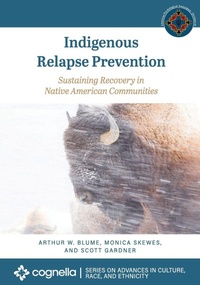
Indigenous Relapse Prevention
Sustaining Recovery in Native American Communities
Published on 30. January 2021
Book
Paperback/Softback
146 pages
978-1-7935-2068-5 (ISBN)
Description
Indigenous Relapse Prevention: Sustaining Recovery in Native American Communities combines the resilient strengths of Indigenous cultural beliefs and practices with empirically supported methods to help readers better understand and address relapse processes.
The text recognizes that mainstream relapse prevention programs must be adapted to better serve American Indian and Alaska Native clients. It leverages the Indigenist Relapse Prevention Model to offer a strengths-based, culturally grounded treatment model that assists individuals in overcoming threats to recovery. The model addresses Indigenous-specific issues related to substance use and recovery that are frequently not addressed in other programs, such as triggers related to racism, lateral violence, and intergenerational trauma. The program reflects an Indigenous worldview, emphasizes the role of spirituality in wellness, and is intended to restore balance and harmony in the lives of clients through an appreciation of the sacredness of Creation and self.
Indigenous Relapse Prevention is part of the Cognella Series on Advances in Culture, Race, and Ethnicity. The series, co-sponsored by Division 45 of the American Psychological Association, addresses critical and emerging issues within culture, race, and ethnic studies, as well as specific topics among key ethnocultural groups.
The text recognizes that mainstream relapse prevention programs must be adapted to better serve American Indian and Alaska Native clients. It leverages the Indigenist Relapse Prevention Model to offer a strengths-based, culturally grounded treatment model that assists individuals in overcoming threats to recovery. The model addresses Indigenous-specific issues related to substance use and recovery that are frequently not addressed in other programs, such as triggers related to racism, lateral violence, and intergenerational trauma. The program reflects an Indigenous worldview, emphasizes the role of spirituality in wellness, and is intended to restore balance and harmony in the lives of clients through an appreciation of the sacredness of Creation and self.
Indigenous Relapse Prevention is part of the Cognella Series on Advances in Culture, Race, and Ethnicity. The series, co-sponsored by Division 45 of the American Psychological Association, addresses critical and emerging issues within culture, race, and ethnic studies, as well as specific topics among key ethnocultural groups.
More details
Language
English
Place of publication
San Diego
United States
Target group
Professional and scholarly
Dimensions
Height: 254 mm
Width: 178 mm
Thickness: 9 mm
Weight
289 gr
ISBN-13
978-1-7935-2068-5 (9781793520685)
Copyright in bibliographic data and cover images is held by Nielsen Book Services Limited or by the publishers or by their respective licensors: all rights reserved.
Schweitzer Classification
Persons
Arthur W. Blume is an Indigenous American psychologist, a professor of clinical psychology at Washington State University Vancouver, and a President's Professor at the University of Alaska Fairbanks Center for Alaska Native Health Research.
Monica Skewes is an associate professor of psychology and an investigator with the Center for American Indian and Rural Health Equity at Montana State University. She is a member of the Robert Wood Johnson Foundation's Interdisciplinary Research Leaders program.
Scott Gardner is a licensed addiction counselor at the Gallatin County Community Mental Health center and a consultant on the Indigenous Relapse Prevention project funded by the Center for American Indian and Rural Health Equity at Montana State University.
Monica Skewes is an associate professor of psychology and an investigator with the Center for American Indian and Rural Health Equity at Montana State University. She is a member of the Robert Wood Johnson Foundation's Interdisciplinary Research Leaders program.
Scott Gardner is a licensed addiction counselor at the Gallatin County Community Mental Health center and a consultant on the Indigenous Relapse Prevention project funded by the Center for American Indian and Rural Health Equity at Montana State University.