

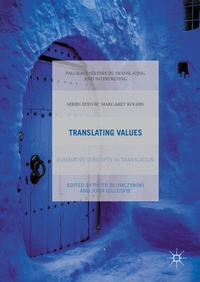
Translating Values
Evaluative Concepts in Translation
Published on 11. July 2016
Book
Hardback
XV, 363 pages
978-1-137-54970-9 (ISBN)
Description
This collection explores the central importance of values and evaluative concepts in cross-cultural translational encounters. Written by a group of international scholars from a diverse range of linguistic and cultural backgrounds, the chapters in this book consider what it means to translate cultures by examining core values and their relationship to key evaluative concepts (such as authenticity, clarity, home, honour, or justice) and how they influence the complex multidimensional process of translation. This book will be of interest to academics studying cross-cultural and inter-linguistic interactions, to translators and interpreters, students of translation and of modern languages, and all those dealing with multilingual and multicultural settings.
Reviews / Votes
"Showing a predominantly theoretical and philosophical orientation, Translating Values gives food for thought about abstract notions such as culture as an identity shaper, or the burning issue of our stance towards alterity. . Translating Values might find its place on the reading lists of cultural and translation studies scholars." (Andrea Stojilkov, Target, Vol. 29 (2), 2017)More details
Series
Edition
1st ed. 2016
Language
English
Place of publication
London
United Kingdom
Target group
Professional and scholarly
Illustrations
1 s/w Abbildung, 1 farbige Abbildung
XV, 363 p. 2 illus., 1 illus. in color.
Dimensions
Height: 216 mm
Width: 153 mm
Thickness: 25 mm
Weight
603 gr
ISBN-13
978-1-137-54970-9 (9781137549709)
DOI
10.1057/978-1-137-54971-6
Schweitzer Classification
Other editions
Additional editions

Book
07/2016
Palgrave Macmillan
€106.99
The article will not be published
E-Book
06/2016
1st Edition
Palgrave Macmillan
€79.99
Available for download
Persons
Piotr Blumczynski is Lecturer in Translation and Interpreting at Queen's University Belfast. His research and teaching focus on translation theory and practice, translation of sacred texts, ethics, ethnolinguistics and cognitive semantics. He has published two monographs:
Doctrine in Translation
(2006) and
Ubiquitous Translation
(2016). He is Associate Editor of the journal
Translation Studies
.
John Gillespie is Professor of French Language and Literature (Emeritus), a member of the Arts and Humanities Research Institute and a former Head of Languages and Literature at Ulster University. Apart from translation studies, his research interests include Gide, Sartre (he is co-editor of Sartre Studies International ), Camus, existentialism, the interactions between literature, philosophy, theology and belief in twentieth-century literature and culture, and applied linguistics.
John Gillespie is Professor of French Language and Literature (Emeritus), a member of the Arts and Humanities Research Institute and a former Head of Languages and Literature at Ulster University. Apart from translation studies, his research interests include Gide, Sartre (he is co-editor of Sartre Studies International ), Camus, existentialism, the interactions between literature, philosophy, theology and belief in twentieth-century literature and culture, and applied linguistics.
Content
Introduction.- Chapter 1: Who Wants Walls? An Ethnolinguistics of Insides and Outsides.- Chapter 2: Emotional Valuation: Values and Emotions in Translation.- Chapter 3: Alternative Evaluative Concepts to the Trinity of Bible Translation.- Chapter 4: Submission and Its Conflicting Value Systems: A Case Study.- Chapter 5: Re-examining Islamic Evaluative Concepts in English Translations of the Quran: Friendship, Justice and Retaliation.- Chapter 6: English Evaluative Concepts in a Contemporary Devotional Christian Text. A Comparative Study of Dzienniczek by Faustyna Kowalska and Its English Translation.- Chapter 7: Clarity, Soberness, Chastity: Politics of Simplicity in Nineteenth-Century Translation.- Chapter 8: Letters to Italy: Translation and Religion in Nineteenth-Century Ireland.- Chapter 9: Improving the Public: Translating 'Protestant' Values through Nineteenth-Century Bilingual Print Journalism in South Asia .- Chapter 10: Translating Protestant Christianity into China - Questions of Indigenization and Sinification in a Globalised World.- Chapter 11: Translating the Past: the Moral Universe of Calderón's Painter of Dishonour.- Chapter 12: Beckett as Translator of Beckett: the Transmission of (Anti-?) Religious Concepts.- Chapter 13: Vulnerable Values: The Polish dom ('house, home') in English Translation.- Chapter 14: Smart Dreamers: Translation and the Culture of Speculative Fiction.- Chapter 15: Translation as an Evaluative Concept.