

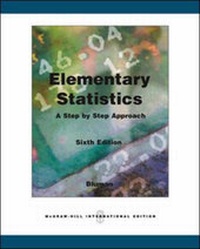
Elementary Statistics
A Step by Step Approach
6th Edition
Published on 1. January 2006
Book
Paperback/Softback
978-0-07-126703-8 (ISBN)
Description
"Elementary Statistics: A Step by Step Approach" is for general beginning statistics courses with a basic algebra prerequisite. The book is non-theoretical, explaining concepts intuitively and teaching problem solving through worked examples and step-by-step instructions. This edition places more emphasis on conceptual understanding and understanding results. This edition also features increased emphasis on Excel, Minitab, and the TI-83 Plus and TI 84-Plus graphing calculators, computing technologies commonly used in such courses.
More details
Edition
6th edition
Language
English
Place of publication
London
United States
Publishing group
McGraw-Hill Education - Europe
Target group
College/higher education
Dimensions
Height: 271 mm
Width: 215 mm
Thickness: 32 mm
Weight
1674 gr
ISBN-13
978-0-07-126703-8 (9780071267038)
Copyright in bibliographic data and cover images is held by Nielsen Book Services Limited or by the publishers or by their respective licensors: all rights reserved.
Schweitzer Classification
Person
Allan G. Bluman is Professor of Mathematics at Community College of Allegheny County, near Pittsburgh. For the McKeesport and New Kensington Campuses of Pennsylvania State University, he has taught teacher-certification and graduate education statistics courses. Prior to his college teaching, he taught mathematics at a junior high school. Professor Bluman received his B.S. from California State College in California, Penn.; his M.Ed. from the University of Pittsburgh; and, in 1971, his Ed.D., also from the University of Pittsburgh. His major field of study was mathematics education. In addition to Elementary Statistics: A Step by Step Approach, Third Edition, and Elementary Statistics: A Brief Version, the author has published several professional articles and the Modern Math Fun Book (Cuisenaire Publishing Company). He has spoken and presided at national and local mathematics conferences and has served as newsletter editor for the Pennsylvania State Mathematics Association of Two-Year Colleges. He is a member of the American Statistical Association, the National Council of Teachers of Mathematics, and the Mathematics Council of Western Pennsylvania. Al Bluman is married and has two children. His hobbies include writing, bicycling, and swimming.
Content
1 The Nature of Probability and Statistics 1-1 Introduction 1-2 Descriptive and Inferential Statistics 1-3 Variables and Types of Data 1-4 Data Collection and Sampling Techniques 1-5 Observational and Experimental Studies 1-6 Uses and Misuses of Statistics 1-7 Computers and Calculators 1-8 Summary 2 Frequency Distributions and Graphs 2-1 Introduction 2-2 Organizing Data 2-3 Histograms, Frequency Polygons, and Ogives 2-4 Other Types of Graphs 2-5 Summary3 Data Description 3-1 Introduction 3-2 Measures of Central Tendency 3-3 Measures of Variation 3-4 Measures of Position 3-5 Exploratory Data Analysis 3-6 Summary4 Probability and Counting Rules 4-1 Introduction 4-2 Sample Spaces and Probability 4-3 The Addition Rules for Probability 4-4 The Multiplication Rules and Conditional Probability 4-5 Counting Rules 4-6 Probability and Counting Rules 4-7 Summary5 Discrete Probability Distributions 5-1 Introduction 5-2 Probability Distributions 5-3 Mean, Variance, Standard Deviation, and Expectation 5-4 The Binomial Distribution 5-5 Other Types of Distributions (Optional) 5-6 Summary6 The Normal Distribution 6-1 Introduction 6-2 Properties of the Normal Distribution 6-3 The Standard Normal Distribution 6-4 Applications of the Normal Distribution 6-5 The Central Limit Theorem 6-6 The Normal Approximation to the Binomial Distribution 6-7 Summary 7 Confidence Intervals and Sample Size 7-1 Introduction 7-2 Confidence Intervals for the Mean (s Known or nA30) and Sample Size 7-3 Confidence Intervals for the Mean (s Unknown or n<30) 7-4 Confidence Intervals and Sample Size for Proportions 7-5 Confidence Intervals for Variances and Standard Deviations 7-6 Summary 8 Hypothesis Testing 8-1 Introduction 8-2 Steps in Hypothesis Testing - Traditional Method 8-3 z Test for a Mean 8-4 t Test for a Mean 8-5 z Test for a Proportion 8-6 Chi Square test for a Variance or Standard Deviation 8-7 Additional Topics Regarding Hypothesis Testing 8-8 Summary9 Testing the Difference Between Two Means, Two Variances, and Two Proportions 9-1 Introduction 9-2 Testing the Difference Between Two Means: Large Samples 9-3 Testing the Difference Between Two Variances 9-4 Testing the Difference Between Two Means: Small Independent Samples 9-5 Testing the Difference Between Two Means: Small Dependent Samples 9-6 Testing the Difference Between Proportions 9-7 Summary 10 Correlation and Regression 10-1 Introduction 10-2 Scatter Plots 10-3 Correlation 10-4 Regression 10-5 Coefficient of Determination and Standard Error of the Estimate 10-6 Multiple Regression (Optional) 10-7 Summary 11 Other Chi-Square Tests 11-1 Introduction 11-2 Test for Goodness of Fit 11-3 Tests Using Contingency Tables 11-4 Summary12 Analysis of Variance 12-1 Introduction 12-2 One-Way Analysis of Variance 12-3 The Scheffe Test and the Tukey Test 12-4 Two-Way Analysis of Variance 12-5 Summary 13 Nonparametric Statistics 13-1 Introduction 13-2 Advantages and Disadvantages of Nonparametric Methods 13-3 The Sign Test 13-4 The Wilcoxon Rank Sum Test 13-5 The Wilcoxon Signed-Rank Test 13-6 The Kruskal-Wallis Test 13-7 The Spearman Rank Correlation Coefficient and the Runs Test 13-8 Summary 14 Sampling and Simulation 14-1 Introduction 14-2 Common Sampling Techniques 14-3 Surveys and Questionnaire Design 14-4 Simulation Techniques 14-5 The Monte Carlo Method 14-6 Summary Appendix A: Algebra Review Appendix B-1: Writing the Research Report Appendix B-2: Bayes's Theorem Appendix B-3: Alternate Method for the Standard Normal Distribution Appendix C: Tables Appendix D: Data Bank Appendix E: Glossary Appendix F: Bibliography Appendix G: Photo Credits Appendix H: Selected Answers