

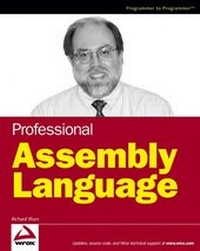
Professional Assembly Language
Published on 11. February 2005
Book
Paperback/Softback
576 pages
978-0-7645-7901-1 (ISBN)
Description
* Unlike high-level languages such as Java and C++, assembly language is much closer to the machine code that actually runs computers; it's used to create programs or modules that are very fast and efficient, as well as in hacking exploits and reverse engineering
* Covering assembly language in the Pentium microprocessor environment, this code-intensive guide shows programmers how to create stand-alone assembly language programs as well as how to incorporate assembly language libraries or routines into existing high-level applications
* Demonstrates how to manipulate data, incorporate advanced functions and libraries, and maximize application performance
* Examples use C as a high-level language, Linux as the development environment, and GNU tools for assembling, compiling, linking, and debugging
More details
Product info
WebSite Associated w/Book
Edition
1. Auflage
Language
English
Place of publication
United States
Publishing group
John Wiley & Sons Inc
Target group
Professional and scholarly
Illustrations
Drawings: 76 B&W, 0 Color; Tables: 86 B&W, 0 Color
Dimensions
Height: 235 mm
Width: 191 mm
Thickness: 31 mm
Weight
1061 gr
ISBN-13
978-0-7645-7901-1 (9780764579011)
Schweitzer Classification
Other editions
Additional editions
Person
Richard Blum has worked for a large U.S. government organization for more than 15 years. During that time, he has had the opportunity to program utilities in various programming languages: C, C++, Java, and Microsoft VB.NET and C#. With this experience, Rich has often found the benefit of reviewing assembly language code generated by compilers and utilizing assembly language routines to speed up higher-level language programs.
Rich has a bachelor of science degree in electrical engineering from Purdue University, where he worked on many assembly language projects. (Of course, this was back in the eight-bit processor days.) He also has a master of science degree in management from Purdue University, specializing in Management Information Systems.
Content
Acknowledgments.
Contents.
Introduction.
Chapter 1: What Is Assembly Language?
Chapter 2: The IA-32 Platform.
Chapter 3: The Tools of the Trade.
Chapter 4: A Sample Assembly Language Program.
Chapter 5: Moving Data.
Chapter 6: Controlling Execution Flow.
Chapter 7: Using Numbers.
Chapter 8: Basic Math Functions.
Chapter 9: Advanced Math Functions.
Chapter 10: Working with Strings.
Chapter 11: Using Functions.
Chapter 12: Using Linux System Calls.
Chapter 13: Using Inline Assembly.
Chapter 14: Calling Assembly Libraries.
Chapter 15: Optimizing Routines.
Chapter 16: Using Files.
Chapter 17: Using Advanced IA-32 Features.
Index.