

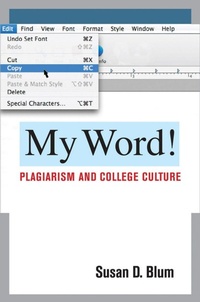
My Word!
Plagiarism and College Culture
Published on 15. December 2010
Book
Paperback/Softback
240 pages
978-0-8014-7661-7 (ISBN)
Description
"Classroom Cheats Turn to Computers." "Student Essays on Internet Offer Challenge to Teachers." "Faking the Grade." Headlines such as these have been blaring the alarming news of an epidemic of plagiarism and cheating in American colleges: more than 75 percent of students admit to having cheated; 68 percent admit to cutting and pasting material from the Internet without citation.
Professors are reminded almost daily that many of today's college students operate under an entirely new set of assumptions about originality and ethics. Practices that even a decade ago would have been regarded almost universally as academically dishonest are now commonplace. Is this development an indication of dramatic shifts in education and the larger culture? In a book that dismisses hand-wringing in favor of a rich account of how students actually think and act, Susan D. Blum discovers two cultures that exist, often uneasily, side by side in the classroom.
Relying extensively on interviews conducted by students with students, My Word! presents the voices of today's young adults as they muse about their daily activities, their challenges, and the meanings of their college lives. Outcomes-based secondary education, the steeply rising cost of college tuition, and an economic climate in which higher education is valued for its effect on future earnings above all else: These factors each have a role to play in explaining why students might pursue good grades by any means necessary. These incentives have arisen in the same era as easily accessible ways to cheat electronically and with almost intolerable pressures that result in many students being diagnosed as clinically depressed during their transition from childhood to adulthood.
However, Blum suggests, the real problem of academic dishonesty arises primarily from a lack of communication between two distinct cultures within the university setting. On one hand, professors and administrators regard plagiarism as a serious academic crime, an ethical transgression, even a sin against an ethos of individualism and originality. Students, on the other hand, revel in sharing, in multiplicity, in accomplishment at any cost. Although this book is unlikely to reassure readers who hope that increasing rates of plagiarism can be reversed with strongly worded warnings on the first day of class, My Word! opens a dialogue between professors and their students that may lead to true mutual comprehension and serve as the basis for an alignment between student practices and their professors' expectations.
Professors are reminded almost daily that many of today's college students operate under an entirely new set of assumptions about originality and ethics. Practices that even a decade ago would have been regarded almost universally as academically dishonest are now commonplace. Is this development an indication of dramatic shifts in education and the larger culture? In a book that dismisses hand-wringing in favor of a rich account of how students actually think and act, Susan D. Blum discovers two cultures that exist, often uneasily, side by side in the classroom.
Relying extensively on interviews conducted by students with students, My Word! presents the voices of today's young adults as they muse about their daily activities, their challenges, and the meanings of their college lives. Outcomes-based secondary education, the steeply rising cost of college tuition, and an economic climate in which higher education is valued for its effect on future earnings above all else: These factors each have a role to play in explaining why students might pursue good grades by any means necessary. These incentives have arisen in the same era as easily accessible ways to cheat electronically and with almost intolerable pressures that result in many students being diagnosed as clinically depressed during their transition from childhood to adulthood.
However, Blum suggests, the real problem of academic dishonesty arises primarily from a lack of communication between two distinct cultures within the university setting. On one hand, professors and administrators regard plagiarism as a serious academic crime, an ethical transgression, even a sin against an ethos of individualism and originality. Students, on the other hand, revel in sharing, in multiplicity, in accomplishment at any cost. Although this book is unlikely to reassure readers who hope that increasing rates of plagiarism can be reversed with strongly worded warnings on the first day of class, My Word! opens a dialogue between professors and their students that may lead to true mutual comprehension and serve as the basis for an alignment between student practices and their professors' expectations.
Reviews / Votes
Like Margaret Mead among the Samoans, Blum views her subjects-digital natives-as an exotic species. She notes their constant use of email, text messaging and the Internet. She declares them to be 'the wordiest and most writerly generation in a long while' and anoints their conversational tendency to quote TV shows and films an admirable form of 'intertextuality.' They are 'storming the barricades' of a new digital future, she claims, using the Internet to engage in collaborative work and to expand their knowledge base. She finds the hapless faculty members charged with teaching such students 'embattled and bewildered.' In other words: Get Twittering, grandma. Blum also embraces various postmodern theories of plagiarism. Internet-savvy, intertextual ingenues don't steal words; they engage in 'patchwriting' and 'pastiche,' constructing essays the way they create eclectic music playlists for their iPods. This practice, she argues, can be viewed as a form of homage or reverence as much as theft. In fact, as Ms. Blum's research demonstrates, students today view writing - however we might define such a thing in a 'pastiche' culture - as a purely instrumental activity: a means to an end.(Wall Street Journal)
More details
Language
English
Place of publication
Ithaca
United States
Product notice
Paperback (trade)
Dimensions
Height: 233 mm
Width: 156 mm
Thickness: 15 mm
Weight
326 gr
ISBN-13
978-0-8014-7661-7 (9780801476617)
Copyright in bibliographic data and cover images is held by Nielsen Book Services Limited or by the publishers or by their respective licensors: all rights reserved.
Schweitzer Classification
Other editions
Additional editions

E-Book
06/2011
Cornell University Press
€9.49
Available for download
Person
Susan D. Blum is Professor of Anthropology at the University of Notre Dame. She is the author, most recently, of Lies That Bind: Chinese Truth, Other Truths and editor of Making Sense of Language: Readings in Culture and Communication.
Content
Introduction: Plagiarism in College1 A Question of Judgment: Plagiarism Is Not One Thing, Once and for All2 Intertexuality, Authorship, and Plagiarism: My Word, Your Word, Their Word -> Our Word3 Observing the Performance Self: Multiplicity versus
Authenticity4 Growing Up in the College Bubble: The Tasks and Temptations
of Adolescence5 No Magic Bullet: Deconstructing PlagiarismConclusion: What Is to Be Done?Notes
Bibliography
Acknowledgments
Index
Authenticity4 Growing Up in the College Bubble: The Tasks and Temptations
of Adolescence5 No Magic Bullet: Deconstructing PlagiarismConclusion: What Is to Be Done?Notes
Bibliography
Acknowledgments
Index