

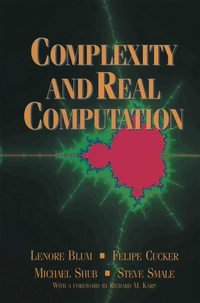
Complexity and Real Computation
Published on 10. October 2012
Book
Paperback/Softback
XVI, 453 pages
978-1-4612-6873-4 (ISBN)
Description
Computational complexity theory provides a framework for understanding the cost of solving computational problems, as measured by the requirement for resources such as time and space. The objects of study are algorithms defined within a formal model of computation. Upper bounds on the computational complexity of a problem are usually derived by constructing and analyzing specific algorithms. Meaningful lower bounds on computational complexity are harder to come by, and are not available for most problems of interest. The dominant approach in complexity theory is to consider algorithms as oper ating on finite strings of symbols from a finite alphabet. Such strings may represent various discrete objects such as integers or algebraic expressions, but cannot rep resent real or complex numbers, unless the numbers are rounded to approximate values from a discrete set. A major concern of the theory is the number of com putation steps required to solve a problem, as a function of the length of the input string.
More details
Edition
Softcover reprint of the original 1st ed. 1998
Language
English
Place of publication
New York
United States
Target group
Professional and scholarly
Research
Illustrations
XVI, 453 p.
Dimensions
Height: 235 mm
Width: 155 mm
Thickness: 26 mm
Weight
709 gr
ISBN-13
978-1-4612-6873-4 (9781461268734)
DOI
10.1007/978-1-4612-0701-6
Schweitzer Classification
Other editions
Additional editions
Lenore Blum | Felipe Cucker | Michael Shub
Complexity and Real Computation
E-Book
12/2012
Springer
€53.49
Available for download
Lenore Blum | Felipe Cucker | Michael Shub
Complexity and Real Computation
Book
10/1997
Springer
€85.55
Shipment within 5-7 days
Content
1 Introduction.- 2 Definitions and First Properties of Computation.- 3 Computation over a Ring.- 4 Decision Problems and Complexity over a Ring.- 5 The Class NP and NP-Complete Problems.- 6 Integer Machines.- 7 Algebraic Settings for the Problem "P ? NP?".- 8 Newton's Method.- 9 Fundamental Theorem of Algebra: Complexity Aspects.- 10 Bézout's Theorem.- 11 Condition Numbers and the Loss of Precision of Linear Equations.- 12 The Condition Number for Nonlinear Problems.- 13 The Condition Number in ?(H(d).- 14 Complexity and the Condition Number.- 15 Linear Programming.- 16 Deterministic Lower Bounds.- 17 Probabilistic Machines.- 18 Parallel Computations.- 19 Some Separations of Complexity Classes.- 20 Weak Machines.- 21 Additive Machines.- 22 Nonuniform Complexity Classes.- 23 Descriptive Complexity.- References.