

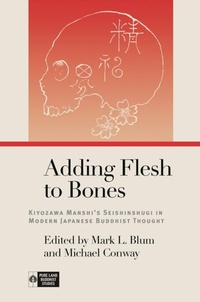
Adding Flesh to Bones
Kiyozawa Manshi's Seishinshugi in Modern Japanese Buddhist Thought
Will be published approx. on 30. April 2022
Book
Hardback
488 pages
978-0-8248-9207-4 (ISBN)
Description
This collection of seventeen essays situates modern Shin Buddhist thinker Kiyozawa Manshi (1863-1903) and his new form of spirituality, Seishinshugi, in the broader context of Buddhism and religious thought in modern Japan. The work highlights several factors that led to the development of Kiyozawa's ideas and demonstrates the broad influence that he and his disciples had, putting in relief both the events that led Kiyozawa to set forth his unique formulation of a modern Shin Buddhist religiosity in Seishinshugi and the ways in which those ideas became a force that shaped a large part of Japan's religious landscape well past the middle of the twentieth century.
The book is made up of historical studies that explore the significance of Seishinshugi from a variety of perspectives and chapters that attempt to introduce some of the original ideas of Seishinshugi thinkers and other modern Shin proponents such as Sasaki Gessho (1875-1926) and Yasuda Rijin (1900-1982). The inclusion of several translations of recent Japanese scholarship on Kiyozawa and Seishinshugi provides a snapshot of the state of the field for Kiyozawa studies today in Japan.
Several early chapters present issues that Kiyozawa addressed in his formulations of Seishinshugi. His relationship with Inoue Enryo (1858-1919) is discussed in depth, as is his understanding of the Tannisho and new research indicating that Seishinshugi might more closely represent the thought of Kiyozawa's disciples than his own. This portion ends with a consideration of the reinvention of Kiyozawa's historical image by his followers after his death. Later chapters bring together research into the specific ways in which Kiyozawa's legacy shaped the Japanese religious and philosophical environment in the last century, including chapters on female spirituality as expressed in the Seishinshugi movement and the influence of Kiyozawa and Soga Ryojin (1875-1971) on the Kyoto School and its implications. Other essays highlight approaches to finding meaning in Shin doctrines by Sasaki, Soga, and Yasuda, and how D. T. Suzuki, an Otani University colleague, fits into the movement as a whole.
The book is made up of historical studies that explore the significance of Seishinshugi from a variety of perspectives and chapters that attempt to introduce some of the original ideas of Seishinshugi thinkers and other modern Shin proponents such as Sasaki Gessho (1875-1926) and Yasuda Rijin (1900-1982). The inclusion of several translations of recent Japanese scholarship on Kiyozawa and Seishinshugi provides a snapshot of the state of the field for Kiyozawa studies today in Japan.
Several early chapters present issues that Kiyozawa addressed in his formulations of Seishinshugi. His relationship with Inoue Enryo (1858-1919) is discussed in depth, as is his understanding of the Tannisho and new research indicating that Seishinshugi might more closely represent the thought of Kiyozawa's disciples than his own. This portion ends with a consideration of the reinvention of Kiyozawa's historical image by his followers after his death. Later chapters bring together research into the specific ways in which Kiyozawa's legacy shaped the Japanese religious and philosophical environment in the last century, including chapters on female spirituality as expressed in the Seishinshugi movement and the influence of Kiyozawa and Soga Ryojin (1875-1971) on the Kyoto School and its implications. Other essays highlight approaches to finding meaning in Shin doctrines by Sasaki, Soga, and Yasuda, and how D. T. Suzuki, an Otani University colleague, fits into the movement as a whole.
More details
Series
Language
English
Place of publication
Honolulu, HI
United States
Target group
Professional and scholarly
Product notice
sewn/stitched
Cloth over boards
Dimensions
Height: 231 mm
Width: 155 mm
Thickness: 30 mm
Weight
794 gr
ISBN-13
978-0-8248-9207-4 (9780824892074)
Copyright in bibliographic data and cover images is held by Nielsen Book Services Limited or by the publishers or by their respective licensors: all rights reserved.
Schweitzer Classification
Persons
Mark L. Blum is professor and Shinjo Ito Distinguished Chair in Japanese Studies at the University of California, Berkeley.
Michael Conway is associate professor in the Shin Buddhist Studies Department at Otani University.
Richard K. Payne is Yehan Numata Professor of Japanese Buddhist Studies at the Institute of Buddhist Studies, Berkeley.
Robert F. Rhodes is professor of Buddhist studies at Otani University in Kyoto.
James C. Dobbins is Fairchild Professor Emeritus of Religion and East Asian Studies at Oberlin College.
Melissa Anne-Marie Curley is assistant professor in the Department of Comparative Studies at the Ohio State University.
Paul B. Watt is professor at the Center for International Education, Waseda University, and adviser to Waseda's International Division. In the United States, he has taught at Grinnell College and Columbia University and is professor emeritus of Asian studies at DePauw University.
Michael Conway is associate professor in the Shin Buddhist Studies Department at Otani University.
Richard K. Payne is Yehan Numata Professor of Japanese Buddhist Studies at the Institute of Buddhist Studies, Berkeley.
Robert F. Rhodes is professor of Buddhist studies at Otani University in Kyoto.
James C. Dobbins is Fairchild Professor Emeritus of Religion and East Asian Studies at Oberlin College.
Melissa Anne-Marie Curley is assistant professor in the Department of Comparative Studies at the Ohio State University.
Paul B. Watt is professor at the Center for International Education, Waseda University, and adviser to Waseda's International Division. In the United States, he has taught at Grinnell College and Columbia University and is professor emeritus of Asian studies at DePauw University.