

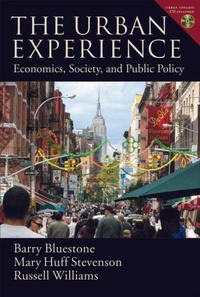
The Urban Experience
Economics, Society, and Public Policy
Published on 21. August 2008
Book
Paperback/Softback
624 pages
978-0-19-531308-6 (ISBN)
Description
The Urban Experience provides a fresh approach to the study of metropolitan areas by combining economic principles, social insight, and political realities with an appreciation of public policy to understand how U.S. cities and suburbs function in the 21st century. The book is grounded in the real life experiences of students and their families on the premise that there is a fascination about one's own surroundings. It uses a great deal of historical and comparative data to explore the wide variation in how we experience urban and suburban communities. It addresses the changing role and function of U.S. metropolitan areas in an age of growing global competition and focuses on key contemporary problems facing cities and suburbs. The book introduces analyses from economics, sociology, and political science as useful tools to understand the evolution and current status of the nation's urban areas.
It is the hope of the authors that after students have taken a one-semester course using this text they will have a much greater appreciation and understanding of cities and suburbs, allowing them to participate more fully in the communities where they work and live.
It is the hope of the authors that after students have taken a one-semester course using this text they will have a much greater appreciation and understanding of cities and suburbs, allowing them to participate more fully in the communities where they work and live.
Reviews / Votes
This superb new text manages to capture the broad historical foundations of urban economics and its public policy implications. But it also covers the waterfront of contemporary debates and dilemmas, including those tied to social and environmental values and approaches to local politics, extremely well. The authors' lively and balanced style is ideal for teaching these important ideas, both the classic and the cutting-edge. * Xavier de Souza Briggs, Associate Professor of Sociology and Urban Planning and Director, The Community Problem-Solving Project, Massachusetts Institute of Technology *More details
Language
English
Place of publication
New York
United States
Target group
College/higher education
Illustrations
101 illustrations
Dimensions
Height: 254 mm
Width: 170 mm
Thickness: 33 mm
Weight
1247 gr
ISBN-13
978-0-19-531308-6 (9780195313086)
Copyright in bibliographic data and cover images is held by Nielsen Book Services Limited or by the publishers or by their respective licensors: all rights reserved.
Schweitzer Classification
Persons
Barry Bluestone grew up in Detroit, Michigan at a time when Detroit was the wealthiest city in the United States--based on the success of the auto industry and the auto workers' union ability to win wage and benefit gains for their members. After completing his B.A., M.A., and Ph.D. in economics from the University of Michigan, he moved to Boston in 1971 when Boston was suffering from high unemployment and an urban fiscal crisis. During the ensuing years, Barry taught at Boston College, University of Massachusetts Boston, and finally Northeastern University and witnessed Boston experience an urban renaissance based on its ability to capitalize on its high tech industries and financial services. He currently lives in Cambridge, Massachusetts.
Mary Huff Stevenson grew up in a Brooklyn slum and a Queens public housing project and has been fascinated with the dynamics of metropolitan areas ever since. She holds a B.A. degree from Brandeis University and a Ph.D. in Economics from the
University of Michigan. A Professor of Economics at the University of Massachusetts Boston, she lives in Brookline, Massachusetts (it reminds her of Queens, but with cleaner streets).
Russell E. Williams was raised in Orangeburg, South Carolina. He was initially introduced to the variety of metro area experiences during childhood visits with relatives in Savannah, Baltimore, and the Baltimore exurbs. Today, the intrigue of urban dynamics is conveyed in his classes at Wheaton College (MA), where he is Assistant Professor of Economics. He holds a B.A. from Amherst College and a Ph.D. in Economics from the University of Massachusetts-Amherst.
Mary Huff Stevenson grew up in a Brooklyn slum and a Queens public housing project and has been fascinated with the dynamics of metropolitan areas ever since. She holds a B.A. degree from Brandeis University and a Ph.D. in Economics from the
University of Michigan. A Professor of Economics at the University of Massachusetts Boston, she lives in Brookline, Massachusetts (it reminds her of Queens, but with cleaner streets).
Russell E. Williams was raised in Orangeburg, South Carolina. He was initially introduced to the variety of metro area experiences during childhood visits with relatives in Savannah, Baltimore, and the Baltimore exurbs. Today, the intrigue of urban dynamics is conveyed in his classes at Wheaton College (MA), where he is Assistant Professor of Economics. He holds a B.A. from Amherst College and a Ph.D. in Economics from the University of Massachusetts-Amherst.
Content
Preface ; Part I - Introduction to Cities and Suburbs ; Chapter 1 - The Wonder and Paradox of Urban Life ; Chapter 2 - How Metro Areas Rank ; Part II - Dynamics of Metropolitan Development ; Chapter 3 - Urban America from the 17th to the Early 20th Century: The Dynamics of City Growth ; Chapter 4 - Cities and Suburbs in the Late 20th Century: The Dynamics Of Metropolitan Expansion ; Chapter 5 - U.S. Metro Areas in the 21st Century: The New Dynamics Of Urban Location ; Part III - Foundations of Metropolitan Area Prosperity ; Chapter 6 - Urban Prosperity and the Role of Trade ; Chapter 7 - Urban Labor Markets and Metro Prosperity ; Chapter 8 - Urban Public Education and Metro Prosperity ; Part IV - Current Policy Issues in Metro Areas ; Chapter 9 - The Urban Public Sector ; Chapter 10 - Urban Physical Infrastructure: Water, Sewer, and Waste/Parks, Libraries, and Transportation ; Chapter 11 - Urban Social Infrastructure: Public Health, Public Safety, and Public Welfare Policy ; Chapter 12 - Urban Housing Markets, Residential Location, and Housing Policy ; Chapter 13 - Land Use Controls, Sprawl, and Smart Growth ; Chapter 14 - Urban Economic Development Strategies ; Chapter 15 - Urban Well-Being, Civility, and Civic Engagement in the 21st Century ; Glossary ; Index ; CD Rom