

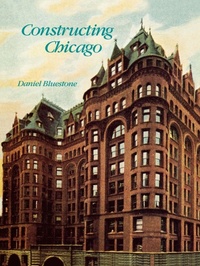
Constructing Chicago
Will be published approx. on 2. August 1993
Book
Paperback/Softback
248 pages
978-0-300-05750-8 (ISBN)
Description
Chicago's impressive industrial expansion in the late nineteenth century convinced most observers that the city was defined by the crass pursuit of wealth and that its architecture was, as described by Lewis Mumford, "a brutal network of industrial necessities." In a major new book, Daniel Bluestone disputes this vision of the city. Combining architectural history and cultural analysis, Bluestone explores the creation of Chicago's parks, churches, skyscrapers, and civic buildings. He finds that the structure of the city was influenced as much by the moral, cultural, and aesthetic aspirations of its local elite as by the untempered forces of commerce and capital.
Bluestone shows how nineteenth-century Chicago architects and their clients attempted to create a distinctive landscape that could distract residents and visitors form the gritty commercial workings of the city while demonstrating a commitment to urbanism that went beyond the marketplace. He surveys the parks that were created to mediate relations between social classes; the churches relocated in residential areas so that they could avoid the dominance of new downtown buildings; the plans for lakefront civic centers architecturally distinguished from the forms of the city's famous early skyscrapers-including the Rookery, the Monadnock, the Columbus Memorial, and the Masonic Temple. And he examines these early Chicago skyscrapers, noting how their monumental entrances, embellished lobbies, artistic elevators, and spacious light courts were designed to soften their commercial edges to recast the city's image, and to cultivate an emerging middle class of white-collar workers. A richly illustrated contribution to urban and architectural history, Bluestone's book is also a perceptive look at central features in the design of this quintessential American city.
Bluestone shows how nineteenth-century Chicago architects and their clients attempted to create a distinctive landscape that could distract residents and visitors form the gritty commercial workings of the city while demonstrating a commitment to urbanism that went beyond the marketplace. He surveys the parks that were created to mediate relations between social classes; the churches relocated in residential areas so that they could avoid the dominance of new downtown buildings; the plans for lakefront civic centers architecturally distinguished from the forms of the city's famous early skyscrapers-including the Rookery, the Monadnock, the Columbus Memorial, and the Masonic Temple. And he examines these early Chicago skyscrapers, noting how their monumental entrances, embellished lobbies, artistic elevators, and spacious light courts were designed to soften their commercial edges to recast the city's image, and to cultivate an emerging middle class of white-collar workers. A richly illustrated contribution to urban and architectural history, Bluestone's book is also a perceptive look at central features in the design of this quintessential American city.
More details
Language
English
Place of publication
United States
Target group
College/higher education
Professional and scholarly
Product notice
Paperback (trade)
Illustrations
148 b-w + 12 color illus.
Dimensions
Height: 279 mm
Width: 210 mm
Thickness: 13 mm
Weight
568 gr
ISBN-13
978-0-300-05750-8 (9780300057508)
Copyright in bibliographic data and cover images is held by Nielsen Book Services Limited or by the publishers or by their respective licensors: all rights reserved.
Schweitzer Classification