

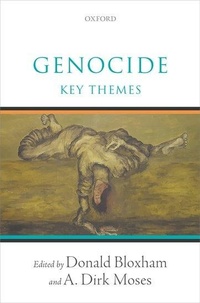
Genocide
Key Themes
Published on 21. April 2022
Book
Paperback/Softback
432 pages
978-0-19-286526-7 (ISBN)
Description
The growth of scholarship on the pressing problem of genocide shows no sign of abating. This volume takes stock of Genocide Studies in all its multi-disciplinary diversity by adopting a thematic rather than case-study approach. Each chapter is by an expert in the field and comprises an up-to-date survey of emerging and established areas of enquiry while highlighting problems and making suggestions about avenues for future research. Each essay also has a select bibliography to facilitate further reading. Key themes include imperial violence and military contexts for genocide, predicting, preventing, and prosecuting genocide, gender, ideology, the state, memory, transitional justice, and ecocide. The volume also scrutinises the concept of genocide - its elasticity, limits, and problems. It does not provide a definition of genocide but rather encourages the reader to think critically about genocide as a conceptual and legal category concerned with identity-based violence against civilians.
More details
Language
English
Place of publication
Oxford
United Kingdom
Target group
College/higher education
Product notice
Paperback (trade)
Unsewn / adhesive bound
Dimensions
Height: 196 mm
Width: 130 mm
Thickness: 24 mm
Weight
463 gr
ISBN-13
978-0-19-286526-7 (9780192865267)
Copyright in bibliographic data and cover images is held by Nielsen Book Services Limited or by the publishers or by their respective licensors: all rights reserved.
Schweitzer Classification
Other editions
Persons
Donald Bloxham is Richard Pares Professor of History at the University of Edinburgh. He was appointed to Edinburgh in 2002 having previously been a Leverhulme Special Research Fellow at the University of Southampton and Research Director at the charity the Holocaust Educational Trust. At Edinburgh he was promoted to a personal chair in modern history in 2007 and to the established Pares chair in 2011. He is the author of seven books and more than sixty journal articles and book chapters. He is a former winner of a Philip Leverhulme Prize and the Raphael Lemkin Award for Genocide Scholarship.
A. Dirk Moses is Frank Porter Graham Distinguished Professor of Global Human Rights History at the University of North Carolina at Chapel Hill. From 2000 to 2010 and 2016 to 2020, he taught at the University of Sydney. Between 2011 and 2015, he held the Chair of Global and Colonial History at the European University Institute, Florence. He is the senior editor of the Journal of Genocide Research.
A. Dirk Moses is Frank Porter Graham Distinguished Professor of Global Human Rights History at the University of North Carolina at Chapel Hill. From 2000 to 2010 and 2016 to 2020, he taught at the University of Sydney. Between 2011 and 2015, he held the Chair of Global and Colonial History at the European University Institute, Florence. He is the senior editor of the Journal of Genocide Research.
Content
Donald Bloxham and A. Dirk Moses: Editors' Introduction
1: A. Dirk Moses: Fit for Purpose? The Concept of Genocide and Civilian Destruction
2: Hollie Nyseth Brehm: Predicting Genocide
3: Deborah Mayersen and Stephen McLoughlin: The Absence of Genocide in the Presence of Risk: When Genocide does not Occur
4: Elisa von Joeden-Forgey: Gender and Genocide
5: Jonathan Leader Maynard: Ideology and Genocide
6: Anton Weiss-Wendt: The State and Genocide
7: Matthias Haeussler, Andreas Stucki, and Lorenzo Veracini: Empire and Genocide
8: Michelle Moyd: War and Genocide
9: Dan Stone and Rebecca Jinks: Memory and Genocide
10: Alex Bellamy and Stephen McLoughlin: Armed intervention in Genocide
11: Donald Bloxham and Devin O. Pendas: Genocide and the Politics of Punishment
12: Rachel Kerr: Genocide and the Limits of Transitional Justice
13: Mark Levene: From Past to Future: Prospects for Genocide and its Avoidance in the Twenty-First Century
1: A. Dirk Moses: Fit for Purpose? The Concept of Genocide and Civilian Destruction
2: Hollie Nyseth Brehm: Predicting Genocide
3: Deborah Mayersen and Stephen McLoughlin: The Absence of Genocide in the Presence of Risk: When Genocide does not Occur
4: Elisa von Joeden-Forgey: Gender and Genocide
5: Jonathan Leader Maynard: Ideology and Genocide
6: Anton Weiss-Wendt: The State and Genocide
7: Matthias Haeussler, Andreas Stucki, and Lorenzo Veracini: Empire and Genocide
8: Michelle Moyd: War and Genocide
9: Dan Stone and Rebecca Jinks: Memory and Genocide
10: Alex Bellamy and Stephen McLoughlin: Armed intervention in Genocide
11: Donald Bloxham and Devin O. Pendas: Genocide and the Politics of Punishment
12: Rachel Kerr: Genocide and the Limits of Transitional Justice
13: Mark Levene: From Past to Future: Prospects for Genocide and its Avoidance in the Twenty-First Century