

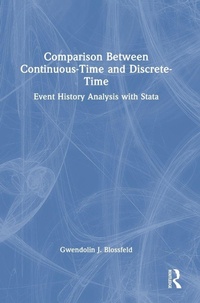
Comparison Between Continuous-Time and Discrete-Time
Event History Analysis with Stata
1st Edition
Published on 30. September 2025
Book
Hardback
142 pages
978-1-032-71738-8 (ISBN)
Description
Comparison Between Continuous-Time and Discrete-Time: Event History Analysis with Stata elucidates the statistical concepts and empirical applications of both continuous-time and discrete-time event history models. Empirical scientists have increasingly collected data on the timing of events, with the understanding that events can occur at any point in time and may be recorded using different observation schemes. However, time-continuous processes are not always observed with fine-grained temporal resolution; in some cases, they are captured with larger observation intervals (monthly, yearly, biennially, and quadrennially).
This book introduces the need for discrete-time event history analysis methods and adeptly discusses the limitations of the discrete-time approach when compared to continuous-time models. It offers an in-depth comparison of both methods and sheds light on how they differ and align. By utilizing the statistical software Stata and using a campus example data set, the book provides practical examples that showcase the implications of larger observation intervals in discrete-time applications.
This book serves as an essential resource for researchers, students, and practitioners seeking to comprehend the nuances of event history analysis in both continuous and discrete-time frameworks. Its comprehensive exploration of statistical techniques and real-world applications will equip readers with a deeper understanding of the strengths and limitations of each method, thus enabling more informed and robust decision-making in empirical research.
This book introduces the need for discrete-time event history analysis methods and adeptly discusses the limitations of the discrete-time approach when compared to continuous-time models. It offers an in-depth comparison of both methods and sheds light on how they differ and align. By utilizing the statistical software Stata and using a campus example data set, the book provides practical examples that showcase the implications of larger observation intervals in discrete-time applications.
This book serves as an essential resource for researchers, students, and practitioners seeking to comprehend the nuances of event history analysis in both continuous and discrete-time frameworks. Its comprehensive exploration of statistical techniques and real-world applications will equip readers with a deeper understanding of the strengths and limitations of each method, thus enabling more informed and robust decision-making in empirical research.
More details
Language
English
Place of publication
London
United Kingdom
Publishing group
Taylor & Francis Ltd
Target group
College/higher education
Professional and scholarly
Postgraduate and Undergraduate Core
Illustrations
58 s/w Abbildungen, 58 s/w Zeichnungen, 31 s/w Tabellen
31 Tables, black and white; 58 Line drawings, black and white; 58 Illustrations, black and white
Dimensions
Height: 250 mm
Width: 175 mm
Thickness: 13 mm
Weight
467 gr
ISBN-13
978-1-032-71738-8 (9781032717388)
Copyright in bibliographic data and cover images is held by Nielsen Book Services Limited or by the publishers or by their respective licensors: all rights reserved.
Schweitzer Classification
Other editions
Additional editions
Gwendolin J. Blossfeld
Comparison Between Continuous-Time and Discrete-Time
Event History Analysis with Stata
E-Book
09/2025
1st Edition
Routledge
€74.99
Available for download
Gwendolin J. Blossfeld
Comparison Between Continuous-Time and Discrete-Time
Event History Analysis with Stata
Book
09/2025
1st Edition
Routledge
€79.90
Shipment within 10-20 days
Gwendolin J. Blossfeld
Comparison Between Continuous-Time and Discrete-Time
Event History Analysis with Stata
E-Book
09/2025
1st Edition
Routledge
€74.99
Available for download
Person
Gwendolin J. Blossfeld is Postdoc at the Faculty of Social Sciences, Economics and Business Administration at the University of Bamberg, Germany. Her research interests are in the areas of longitudinal analysis methods, life course research, longitudinal data collection, causal analysis, sociology of education, labor market research, social inequality, demography, migration, and gender studies. She has published five books and several peer-reviewed journal articles.
Content
1. Introduction. 2. Basic terminology, concepts, and data structures. 3. Statistical models. 4. Comparison of continuous-time and discrete-time exponential transition rate models. 5. Comparison of continuous-time and discrete-time transition rate models with duration dependence. 6. Models with unobserved heterogeneity. 7. Discussion and conclusion. 8. Appendix A: Stata do-files.