

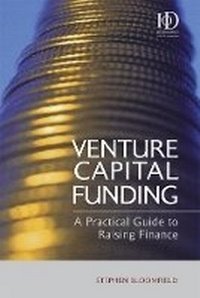
Venture Capital Funding
A Practical Guide to Raising Finance
1st Edition
Published on 3. September 2005
Book
Hardback
224 pages
978-0-7494-4291-0 (ISBN)
Description
After the problems caused by the dot.com boom, there is now renewed interest in venture capital: private equity funds are reporting significantly increased levels of activity both in the UK and worldwide. The Bank of England regards assisting firms to become "investment ready" as the single most important task facing financial professionals over the next decade. This practical handbook provides advice and support for those considering attracting outside funding to their businesses. It describes step by step the mechanics of obtaining venture capital.
Venture Capital Funding is refreshingly informal and conversational in style. Thankfully also jargon-free, it looks at every aspect of this fascinating subject, from deciding when to use outside funding, to post investment considerations such as what running the business with venture capitalists on board entails. The nuts and bolts of actually securing capital is broken down into the key considerations such as: the significance of the business plan, types of investor, targeting and attracting a funder, negotiation and initial valuation, the preliminary offer, detailed description of the "due diligence" process, investor strategies, and the types of investment instruments used. It also explores the variety of reasons for which funding can be sought and discusses the points in the business life cycle for which they are appropriate.
An essential guide, Venture Capital Funding will enable anyone to understand the driving forces behind each stage of the investment process, and equip them to deal with venture capitalists and other professionals involved.
Venture Capital Funding is refreshingly informal and conversational in style. Thankfully also jargon-free, it looks at every aspect of this fascinating subject, from deciding when to use outside funding, to post investment considerations such as what running the business with venture capitalists on board entails. The nuts and bolts of actually securing capital is broken down into the key considerations such as: the significance of the business plan, types of investor, targeting and attracting a funder, negotiation and initial valuation, the preliminary offer, detailed description of the "due diligence" process, investor strategies, and the types of investment instruments used. It also explores the variety of reasons for which funding can be sought and discusses the points in the business life cycle for which they are appropriate.
An essential guide, Venture Capital Funding will enable anyone to understand the driving forces behind each stage of the investment process, and equip them to deal with venture capitalists and other professionals involved.
Reviews / Votes
"Looks at what sort of businesses will be attractive to the different types of VC, the processes of investment, the particular targets of VC funds, and the pressures on the VCs themselves as individual investors." Cambridge Evening News "An easily accessible style - designed for practical use rather than for an academic readership." East Anglian Daily Times "Does a very good job of analysing the different situations which companies might find themselves in when seeking finance and the possible solutions available, and breaks down the process into easily digestible steps." Young Company Finance "Given the failure rate among applicants for VC funding, this volume is extremely welcome and should be viewed as indispensable for anyone who is considering applying." European Business "Valuable, practical advice... This very readable and practical guide represents a valuable information source for SMEs seeking outside finance. It will also be of interest to students and teachers of corporate finance." Economic Outlook and Business Review "The book reads like a cosy chat over a pint with an old pal you've turned to for advice. Bloomfield's easy writing style makes the heavy issues involved with raising capital for business seem so obvious that you could be forgiven for thinking that the process of getting finance will be no sweat at all. If you need to raise money for your business this is a good place to start." Professional ManagerMore details
Language
English
Place of publication
London
United Kingdom
Target group
College/higher education
Professional and scholarly
Product notice
Cloth over boards
Dimensions
Height: 234 mm
Width: 156 mm
ISBN-13
978-0-7494-4291-0 (9780749442910)
Copyright in bibliographic data and cover images is held by Nielsen Book Services Limited or by the publishers or by their respective licensors: all rights reserved.
Schweitzer Classification
Other editions
New editions
Book
08/2008
2nd Edition
Kogan Page Ltd
€63.40
Article is exhausted; no reprint
Person
Stephen Bloomfield is Senior Lecturer in Small Business Development at Ashcroft International Business School. He has an extensive background in venture fund management, and is currently collaborating in a research project with several venture capital funds looking into the way in which funding is being conducted. Stephen also runs his own company, Stormbyrd Pilots Clothing, which was established in 2000 and trades over the Internet. Until recently he was a non-executive director of a number of businesses during periods of financial and organizational restructuring, all of which he helped steer to full recovery.
Content
Why do you want funding? - The strategic considerations; The purposes of outside funding; Determining the exit; Assessing the current management of a business; Dealing with existing shareholder concerns; Choosing an investment vehicle; What the investor looks for; The mechanics of doing the deal; Legal stages; Post investment considerations.
Why do you want funding? - The strategic considerations; The purposes of outside funding; Determining the exit; Assessing the current management of a business; Dealing with existing shareholder concerns; Choosing an investment vehicle; What the investor looks for; The mechanics of doing the deal; Legal stages; Post investment considerations.