

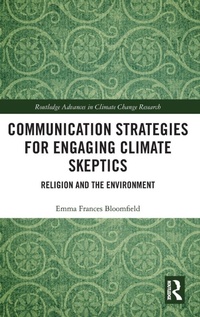
Communication Strategies for Engaging Climate Skeptics
Religion and the Environment
1st Edition
Published on 10. May 2019
Book
Hardback
188 pages
978-1-138-58593-5 (ISBN)
Description
Communication Strategies for Engaging Climate Skeptics examines the intersection of climate skepticism and Christianity and proposes strategies for engaging climate skeptics in productive conversations.
Despite the scientifically established threats of climate change, there remains a segment of the American population that is skeptical of the scientific consensus on climate change and the urgent need for action. One of the most important stakeholders and conversants in environmental conversations is the religious community. While existing studies have discussed environmentalism as a factor within the religious community, this book positions religion as an important factor in environmentalism and focuses on how identities play a role in environmental conversation. Rather than thinking of religious skeptics as a single unified group, Emma Frances Bloomfield argues that it is essential to recognize there are different types of skeptics so that we can better tailor our communication strategies to engage with them on issues of the environment and climate change. To do so, this work breaks skeptics down into three main types: "separators," "bargainers," and "harmonizers." The book questions monolithic understandings of climate skepticism and considers how competing narratives such as religion, economics, and politics play a large role in climate communication. Considering recent political moves to remove climate change from official records and withdraw from international environmental agreements, it is imperative now more than ever to offer practical solutions to academics, practitioners, and the public to change the conversation. To address these concerns, this book provides both a theoretical examination of the rhetoric of religious climate skeptics and concrete strategies for engaging the religious community in conversations about the environment.
This book will be of great interest to students, scholars, and practitioners of climate change science, environmental communication, environmental policy, and religion.
For the 2020 communication awards cycle, Communication Strategies for Engaging Climate Skeptics: Religion and the Environment has won the following distinctions:
Book of the Year - Argumentation and Forensics Division of the National Communication Association
Outstanding Book Award - Spiritual Communication Division of the National Communication Association
Book Award Finalist - Association for the Rhetoric of Science, Technology, and Medicine of the National Communication Association
Despite the scientifically established threats of climate change, there remains a segment of the American population that is skeptical of the scientific consensus on climate change and the urgent need for action. One of the most important stakeholders and conversants in environmental conversations is the religious community. While existing studies have discussed environmentalism as a factor within the religious community, this book positions religion as an important factor in environmentalism and focuses on how identities play a role in environmental conversation. Rather than thinking of religious skeptics as a single unified group, Emma Frances Bloomfield argues that it is essential to recognize there are different types of skeptics so that we can better tailor our communication strategies to engage with them on issues of the environment and climate change. To do so, this work breaks skeptics down into three main types: "separators," "bargainers," and "harmonizers." The book questions monolithic understandings of climate skepticism and considers how competing narratives such as religion, economics, and politics play a large role in climate communication. Considering recent political moves to remove climate change from official records and withdraw from international environmental agreements, it is imperative now more than ever to offer practical solutions to academics, practitioners, and the public to change the conversation. To address these concerns, this book provides both a theoretical examination of the rhetoric of religious climate skeptics and concrete strategies for engaging the religious community in conversations about the environment.
This book will be of great interest to students, scholars, and practitioners of climate change science, environmental communication, environmental policy, and religion.
For the 2020 communication awards cycle, Communication Strategies for Engaging Climate Skeptics: Religion and the Environment has won the following distinctions:
Book of the Year - Argumentation and Forensics Division of the National Communication Association
Outstanding Book Award - Spiritual Communication Division of the National Communication Association
Book Award Finalist - Association for the Rhetoric of Science, Technology, and Medicine of the National Communication Association
More details
Series
Language
English
Place of publication
London
United Kingdom
Publishing group
Taylor & Francis Ltd
Target group
College/higher education
Professional and scholarly
Dimensions
Height: 240 mm
Width: 161 mm
Thickness: 15 mm
Weight
455 gr
ISBN-13
978-1-138-58593-5 (9781138585935)
Copyright in bibliographic data and cover images is held by Nielsen Book Services Limited or by the publishers or by their respective licensors: all rights reserved.
Schweitzer Classification
Other editions
Additional editions
Book
12/2020
1st Edition
Routledge
€54.55
Shipment within 15-20 days
E-Book
05/2019
1st Edition
Routledge
€61.99
Available for download
E-Book
05/2019
1st Edition
Routledge
€61.99
Available for download
Person
Emma Frances Bloomfield is an Assistant Professor in the Department of Communication Studies at the University of Nevada, Las Vegas, USA.
Content
Introduction: The Intersection of Christianity and the Environment 1. Defining the Separators: War, Melodrama, and Authority 2. Separator Strategies: Asking Questions, Accepting Premises, and Making it Personal 3. Defining the Bargainers: Revolution, Modification, and Negotiating with Environmentalism 4. Bargainer Strategies: Working within Frames, Joining the Revolution, and Employing Examples 5. Defining the Harmonizers: Harmony, Collaboration, and Acceptance 6. Harmonizer Strategies: Shifting Frames from Private to Public, Communicating Urgency, and Thinking Globally Conclusion: What We Learn at the Intersection of Christianity and Climate Change Executive Summary: Talking Points and Strategies for Engaging in Climate Change Conversations