

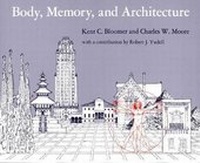
Body, Memory, and Architecture
Will be published approx. on 10. September 1977
Book
Paperback/Softback
159 pages
978-0-300-02142-4 (ISBN)
Description
"A valuable contribution."-Paul Goldberger, New York Times
"Nearly every page of the book is wittily illustrated with cartoons, drawings, and photographs. If the coming generation or architects-and their clients-pay attention to it, America may someday be a much more agreeable place."-John Fischer, Harpers
As teachers of architectural design, Kent Bloomer and Charles Moore have attempted to introduce architecture from the standpoint of how buildings are experienced, how the affect individuals and communities emotionally and provide us with a sense of joy, identity, and place. In giving priority to these issues and in questioning the professional reliance on abstract two-dimensional drawings, they often find themselves in conflict with a general and undebated assumption that architecture is a highly specialized system with a set of prescribed technical goals, rather than a sensual social art historically derived from experiences and memories of the human body. This book, an outgrowth of their joint teaching efforts, places the human body at the center of our understanding of architectural form.
Body, Memory, and Architecture traces the significance of the body from its place as the divine organizing principle in the earliest built forms to its near elimination from architectural thought in this century. The authors draw on contemporary models of spatial perception as well as on body-image theory in arguing for a return of the body to its proper place in the architectural equation.
"Nearly every page of the book is wittily illustrated with cartoons, drawings, and photographs. If the coming generation or architects-and their clients-pay attention to it, America may someday be a much more agreeable place."-John Fischer, Harpers
As teachers of architectural design, Kent Bloomer and Charles Moore have attempted to introduce architecture from the standpoint of how buildings are experienced, how the affect individuals and communities emotionally and provide us with a sense of joy, identity, and place. In giving priority to these issues and in questioning the professional reliance on abstract two-dimensional drawings, they often find themselves in conflict with a general and undebated assumption that architecture is a highly specialized system with a set of prescribed technical goals, rather than a sensual social art historically derived from experiences and memories of the human body. This book, an outgrowth of their joint teaching efforts, places the human body at the center of our understanding of architectural form.
Body, Memory, and Architecture traces the significance of the body from its place as the divine organizing principle in the earliest built forms to its near elimination from architectural thought in this century. The authors draw on contemporary models of spatial perception as well as on body-image theory in arguing for a return of the body to its proper place in the architectural equation.
More details
Language
English
Place of publication
United States
Target group
College/higher education
Professional and scholarly
Product notice
Paperback (trade)
Dimensions
Height: 216 mm
Width: 254 mm
Weight
454 gr
ISBN-13
978-0-300-02142-4 (9780300021424)
Copyright in bibliographic data and cover images is held by Nielsen Book Services Limited or by the publishers or by their respective licensors: all rights reserved.
Schweitzer Classification