

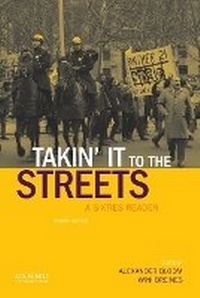
Takin' it to the streets
A Sixties Reader
4th Edition
Published on 16. November 2015
Book
Paperback/Softback
576 pages
978-0-19-025070-6 (ISBN)
Description
The fourth edition of Takin' it to the streets revises the comprehensive collection of primary documents from the 1960s that has become the leading reader about the era. Adopted nationwide, this anthology brings together representative writings, many of which had been unavailable for years or had never been reprinted. Drawn from mainstream sources, little-known sixties periodicals, pamphlets, public speeches, and personal voices, the selections range from
the Port Huron Statement and the NOW Bill of Rights to speeches by Malcolm X, Richard Nixon, Robert Kennedy, and Ronald Reagan, to private letters from civil rights workers and Vietnam
soldiers.
Introductions and headnotes by the editors highlight the importance of particular documents, relating them to each other and placing them within the broader context of the decade. The book focuses on civil rights, Black Power, the counterculture, the women's movement, anti-war activity, gay and lesbian struggles, and the conservative current that ran counter to more typical sixties movements. These include both topics that fell outside the daily attention of the
media and those that made front-page news. Covering an extremely popular period of history, Takin' it to the streets remains the most accessible and authoritative reader of an extraordinary decade, one
unlike any America had seen before or has experienced since.
New to This Edition
* A new section on John F. Kennedy, including Norman Mailer's 1960 assessment of JFK
* New selections on Medgar Evers, Malcolm X, and the Underground Press
* A new chapter of assessments and on the legacy of the 1960s, including articles by Howard Zinn, Fred Barnes, Arthur Schlesinger, and Michael Kazin
the Port Huron Statement and the NOW Bill of Rights to speeches by Malcolm X, Richard Nixon, Robert Kennedy, and Ronald Reagan, to private letters from civil rights workers and Vietnam
soldiers.
Introductions and headnotes by the editors highlight the importance of particular documents, relating them to each other and placing them within the broader context of the decade. The book focuses on civil rights, Black Power, the counterculture, the women's movement, anti-war activity, gay and lesbian struggles, and the conservative current that ran counter to more typical sixties movements. These include both topics that fell outside the daily attention of the
media and those that made front-page news. Covering an extremely popular period of history, Takin' it to the streets remains the most accessible and authoritative reader of an extraordinary decade, one
unlike any America had seen before or has experienced since.
New to This Edition
* A new section on John F. Kennedy, including Norman Mailer's 1960 assessment of JFK
* New selections on Medgar Evers, Malcolm X, and the Underground Press
* A new chapter of assessments and on the legacy of the 1960s, including articles by Howard Zinn, Fred Barnes, Arthur Schlesinger, and Michael Kazin
Reviews / Votes
"'Taking it to the streets' really stands alone--an excellent, well-edited, and well-designed collection of primary sources that is in a class by itself."--Nancy Gabin, Purdue University"There are a number sixties readers available, but 'Taking it to the streets' is by far the most comprehensive. The greatest strength of the book is the breadth of its coverage compared to its competition."--Patrick Jones, University of Nebraska
"From experience, this book functions extremely well in class. It deals with all of the key issues--civil rights, the student movement, the war in Vietnam, and the women's movement."--Allan M. Winkler, Miami University of Ohio
More details
Edition
4th edition
Language
English
Place of publication
New York
United States
Target group
College/higher education
Weight
794 gr
ISBN-13
978-0-19-025070-6 (9780190250706)
Copyright in bibliographic data and cover images is held by Nielsen Book Services Limited or by the publishers or by their respective licensors: all rights reserved.
Schweitzer Classification
Person
Alexander Bloom is Professor of History and American Studies at Wheaton College. He is the author of several books, including Long Time Gone: Sixties America Then and Now (OUP, 2001) and Prodigal Sons: The New York Intellectuals and Their World (OUP, 1987).
Content
Preface
Chapter 1: "Keep on Walkin', Keep on Talkin'": Civil Rights to 1965
Chapter 2:: "My Generation": American Politics, the Student Movement, and the New Left
Chapter 3: "Say it Loud, Say it Proud": Black Nationalism and Ethnic Consciousness
Chapter4: "Hey, Hey, LBJ": Vietnam and the Antiwar Movement
Chapter 5: "Eight Miles High": The Counterculture
Chapter 6: "Love it or Leave it": The Conservative Impulse in a Radical Age
Chapter 7: "The Whole World is Watching": 1968 and After
Chapter 8: "She's Leaving Home": The Women's Liberation Movement
Chapter 9: "When the Music's Over": Endings and Beginnings
Chapter 10: "For What it's Worth": Assessments and Implications
Chapter 1: "Keep on Walkin', Keep on Talkin'": Civil Rights to 1965
Chapter 2:: "My Generation": American Politics, the Student Movement, and the New Left
Chapter 3: "Say it Loud, Say it Proud": Black Nationalism and Ethnic Consciousness
Chapter4: "Hey, Hey, LBJ": Vietnam and the Antiwar Movement
Chapter 5: "Eight Miles High": The Counterculture
Chapter 6: "Love it or Leave it": The Conservative Impulse in a Radical Age
Chapter 7: "The Whole World is Watching": 1968 and After
Chapter 8: "She's Leaving Home": The Women's Liberation Movement
Chapter 9: "When the Music's Over": Endings and Beginnings
Chapter 10: "For What it's Worth": Assessments and Implications