

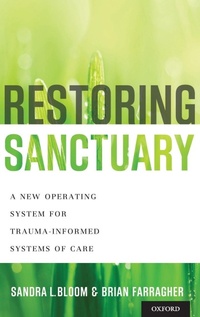
Restoring Sanctuary
A New Operating System for Trauma-Informed Systems of Care
Published on 14. February 2013
Book
Hardback
336 pages
978-0-19-979636-6 (ISBN)
Description
This is the third in a trilogy of books that chronicle the revolutionary changes in our mental health and human service delivery systems that have conspired to disempower staff and hinder client recovery. Creating Sanctuary documented the evolution of The Sanctuary Model therapeutic approach as an antidote to the personal and social trauma that clients bring to child welfare agencies, psychiatric hospitals, and residential facilities. Destroying Sanctuary details the destructive role of organizational trauma in the nation's systems of care. Restoring Sanctuary is a user-friendly manual for organizational change that addresses the deep roots of toxic stress and illustrates how to transform a dysfunctional human service system into a safe, secure, trauma-informed environment.
At its heart, The Sanctuary Model represents an organizational value system that is committed to seven principles, which serve as anchors for decision making at all levels: non-violence, emotional intelligence, social learning, democracy, open communication, social responsibility, and growth and change. The Sanctuary Model is not a clinical intervention; rather, it is a method for creating an organizational culture that can more effectively provide a cohesive context within which healing from psychological and socially derived forms of traumatic experience can be addressed. Chapters are organized around the seven Sanctuary commitments, providing step-by-step, realistic guidance on creating and sustaining fundamental change.
"Restoring Sanctuary" is a roadmap to recovery for our nation's systems of care. It explores the notion that organizations are living systems themselves and as such they manifest various degrees of health and dysfunction, analogous to those of individuals. Becoming a truly trauma-informed system therefore requires a process of reconstitution within helping organizations, top to bottom. A system cannot be truly trauma-informed unless the system can create and sustain a process of understanding itself.
At its heart, The Sanctuary Model represents an organizational value system that is committed to seven principles, which serve as anchors for decision making at all levels: non-violence, emotional intelligence, social learning, democracy, open communication, social responsibility, and growth and change. The Sanctuary Model is not a clinical intervention; rather, it is a method for creating an organizational culture that can more effectively provide a cohesive context within which healing from psychological and socially derived forms of traumatic experience can be addressed. Chapters are organized around the seven Sanctuary commitments, providing step-by-step, realistic guidance on creating and sustaining fundamental change.
"Restoring Sanctuary" is a roadmap to recovery for our nation's systems of care. It explores the notion that organizations are living systems themselves and as such they manifest various degrees of health and dysfunction, analogous to those of individuals. Becoming a truly trauma-informed system therefore requires a process of reconstitution within helping organizations, top to bottom. A system cannot be truly trauma-informed unless the system can create and sustain a process of understanding itself.
Reviews / Votes
'Dr. Bloom, again, offers a unique perspective, well articulated and critically honest about the work necessary to effect the lasting change required for supporting a trauma-informed system of care. She does not minimize the challenges and is careful to describe all dimensions of the effort required to make it an ultimate success. Her time intensive, top down/bottom up, all inclusive exploration may initially be off-putting for some, but for those withforesight - they will quickly grasp the long term benefits and the "profit" that will result from such an endeavor. If the remaining chapters provide similar guidance as found in Chapter 2, the resulting
book will become an invaluable resource on organizational development and change and the "trilogy" could easily be mainstay texts of any curriculum within any organizational psychology department.'--- Sandra Vasko, Mental Health Administrator for Operations, Philadelphia Office of Mental Health, Department of Behavioral Health
'In summary, I recommend the book for publication. It completes the project that the author began with her previous two books, promising a practical approach to dealing with organizational stress that is innovative, unique, and a welcome addition to the literature. It has broad appeal to an academic and practice audience. I would happily add the book to my library and I would also use it for several of the courses I teach on agency-based social work practice
and mental health in Penn's MSW program.'-Linda Hartocollis, Associate Dean for Student Affairs and Director of the Clinical Doctorate in Social Work (DSW) Program at the School of Social Policy &
Practice, University of Pennsylvania
'This is an exceptional, creative volume that integrates a trauma informed model with advanced thinking in organizational development and management. As a road map for change, it is both timely and challenging. Written in an accessible style, the author has woven together from diverse fields an impressive tapestry of cutting edge knowledge that can be readily applied in the mental health, education, justice, and child welfare field. It is obvious that this
model has been honed from experience and extensively reviewed for application. This volume is a unique contribution and definitely should be published.'-Anita Lightburn, Professor and Director, Beck
Institute for Religion and Poverty, Fordham University School of Social Service
More details
Language
English
Place of publication
New York
United States
Target group
Professional and scholarly
Dimensions
Height: 240 mm
Width: 161 mm
Thickness: 23 mm
Weight
669 gr
ISBN-13
978-0-19-979636-6 (9780199796366)
Copyright in bibliographic data and cover images is held by Nielsen Book Services Limited or by the publishers or by their respective licensors: all rights reserved.
Schweitzer Classification
Other editions
Additional editions
Sandra L. Bloom | Brian Farragher
Restoring Sanctuary
A New Operating System for Trauma-Informed Systems of Care
E-Book
01/2013
1st Edition
OUP eBook
€55.49
Available for download
Persons
Sandra L. Bloom, MD, is Associate Professor of Health Management & Policy, School of Public Health, Drexel University.Brian Farragher, MBA, is Executive Vice President and Chief Operating Officer, The Andrus Children's Center.
Author
Associate Professor of Health Management & PolicyAssociate Professor of Health Management & Policy, School of Public Health, Drexel University, Philadelphia, PA
Executive Vice President and Chief Operating OfficerExecutive Vice President and Chief Operating Officer, The Andrus Children's Center, Yonkers, NY
Content
Chapter 1: It Starts with a Dream ; Chapter 2: Turning imagination into Reality: A Vision of Health ; Chapter 3: Growth and Change: Isn't This the Whole Point? ; Chapter 4: Commitment to Democracy ; Chapter 5: Commitment to Nonviolence ; Chapter 6: Commitment to Emotional Intelligence ; Chapter 7: Commitment to Social Learning ; Chapter 8: Commitment to Open Communication ; Chapter 9: Commitment to Social Responsibility ; Chapter 10: Pulling It All Together