

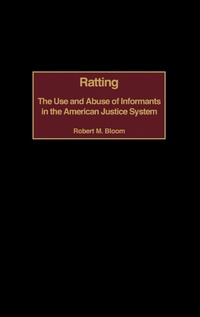
Ratting
The Use and Abuse of Informants in the American Justice System
Published on 30. May 2002
Book
Hardback
216 pages
978-0-275-96818-2 (ISBN)
Description
Showing informants in a variety of contexts provides a broader picture of them, and highlights the potential pitfalls associated with their use within our criminal justice system. Police depend on insiders to prosecute the perpetrators of many of the so-called victimless crimes like drug dealing, money laundering and political corruption. As victimless crimes have grown, so has the use of informants. Providing insights into law enforcement techniques as well as the Court's response to them, Bloom illuminates the pernicious legal ramifications that can result from the justice system's relationship to and use of informers. Law professors, criminologists, and law enforcement scholars will find Bloom's account of this much used and abused but under-reported aspect of America's law enforcement efforts both edifying and sobering.
There are different kinds of informants. Some are used to infiltrate and destroy organized crime operations, and others, such as Linda Tripp, are used to investigate government officials. Informants are motivated by a variety of reasons, including financial gain, political power, elimination of competition, and avoiding criminal punishment. Some are even imaginary, fabricated by police to justify their activity. Bloom discusses each type of informer, grounding his commentary in real cases, some well known, others obscure. He then concludes by suggesting how potential and real abuses of the informant system can be curbed.
There are different kinds of informants. Some are used to infiltrate and destroy organized crime operations, and others, such as Linda Tripp, are used to investigate government officials. Informants are motivated by a variety of reasons, including financial gain, political power, elimination of competition, and avoiding criminal punishment. Some are even imaginary, fabricated by police to justify their activity. Bloom discusses each type of informer, grounding his commentary in real cases, some well known, others obscure. He then concludes by suggesting how potential and real abuses of the informant system can be curbed.
More details
Language
English
Place of publication
United States
Publishing group
Bloomsbury Publishing Plc
Target group
College/higher education
Professional and scholarly
Dimensions
Height: 240 mm
Width: 161 mm
Thickness: 16 mm
Weight
493 gr
ISBN-13
978-0-275-96818-2 (9780275968182)
Copyright in bibliographic data and cover images is held by Nielsen Book Services Limited or by the publishers or by their respective licensors: all rights reserved.
Schweitzer Classification
Other editions
Additional editions
E-Book
05/2002
1st Edition
Praeger Publishers Inc
€94.99
Available for download
Person
ROBERT M. BLOOM is Professor of Law at Boston College Law School. He has written extensively in the area of criminal procedure, focusing on police abuses and the Fourth Amendment.
Content
A Historical Overview of Informants The Political Informant The NonExistent Informant Jail House Informants High Level Informants The End of the Story Bibliography Index