

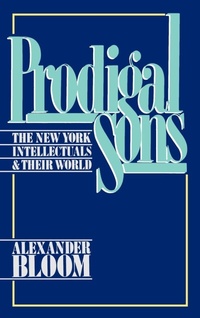
Prodigal Sons
The New York Intellectuals and Their World
Published on 19. February 1987
Book
Hardback
479 pages
978-0-19-503662-6 (ISBN)
Description
"A herd of independent minds," Harold Roseberg once labelled his fellow intellectuals. They were, and are, as this book shows, a special and fascinating group, including literary critics like Lionel Trilling, Alfred Kazin, Irving Howe, Leslie Fiedler, Philip Rahv, and William Phillips; social scientists like Nathan Glazer; art critics and historians Clement Greenberg, Harold Rrosenberg, and Meyer Schapiro; novelist Saul Bellow; and political journalists Irving
Kristol and Norman Podhoretz. Their story winds through nearly all of the crucial intellectual and political events of the last decades, as well as through the major academic institutions of the nation and
the editorial boards of such important journals as Partisan Review, Commentary, Dissent, The Public Interest, and The New York Review of Books. So deeply entrenched in our intellectual establishment are these people that it's easy to forget that most grew up onthe edge of American society--poor, Jewish, the children of immigrants. Prodigal Sons retraces their common past, from their New York City ghetto upbringing and education at Columbia and City College through their
radicalization in the '30s to their preeminence in the postwar literary and academic world. The book examines their youthful efforts to ignore their Jewish heritage and their later rediscovery of this
heritage in the wake of the Holocaust. It shows how they moved toward the liberal center during the Cold War and how the group fragmented in the 1960s, when some turned toward the right, becoming key figures in the Neo-Conservative movement of the 1970s and '80s. As Bloom points out, there is no single typical New York intellectual; nor did they share all their ideas. This book is concerned with how the community came to be formed, and what it thought important, how and
why it moved and changed, and why it ultimately came undone. We learn some of the ways in which intellectuals function and justify their own places and a great deal about the political and cultural
landscape over which New York intellectuals passed. A fascinating portrait of New York intellectual life over the past half-century BLBased on interviews with many of the leading figures and 10 years of extensive research BLTakes us behind the scenes at Commentary, Partisan Review, The Public Interest and other influential publications
Kristol and Norman Podhoretz. Their story winds through nearly all of the crucial intellectual and political events of the last decades, as well as through the major academic institutions of the nation and
the editorial boards of such important journals as Partisan Review, Commentary, Dissent, The Public Interest, and The New York Review of Books. So deeply entrenched in our intellectual establishment are these people that it's easy to forget that most grew up onthe edge of American society--poor, Jewish, the children of immigrants. Prodigal Sons retraces their common past, from their New York City ghetto upbringing and education at Columbia and City College through their
radicalization in the '30s to their preeminence in the postwar literary and academic world. The book examines their youthful efforts to ignore their Jewish heritage and their later rediscovery of this
heritage in the wake of the Holocaust. It shows how they moved toward the liberal center during the Cold War and how the group fragmented in the 1960s, when some turned toward the right, becoming key figures in the Neo-Conservative movement of the 1970s and '80s. As Bloom points out, there is no single typical New York intellectual; nor did they share all their ideas. This book is concerned with how the community came to be formed, and what it thought important, how and
why it moved and changed, and why it ultimately came undone. We learn some of the ways in which intellectuals function and justify their own places and a great deal about the political and cultural
landscape over which New York intellectuals passed. A fascinating portrait of New York intellectual life over the past half-century BLBased on interviews with many of the leading figures and 10 years of extensive research BLTakes us behind the scenes at Commentary, Partisan Review, The Public Interest and other influential publications
Reviews / Votes
'For readers interested in New York intellectual life since the Depression, Prodigal Sons is a concise and highly readable guidebook to what was obviously very exotic and requently very perilous territory to traverse.' KirkusMore details
Language
English
Place of publication
New York
United States
Target group
Professional and scholarly
Dimensions
Height: 235 mm
Width: 157 mm
Thickness: 32 mm
Weight
917 gr
ISBN-13
978-0-19-503662-6 (9780195036626)
Copyright in bibliographic data and cover images is held by Nielsen Book Services Limited or by the publishers or by their respective licensors: all rights reserved.
Schweitzer Classification
Other editions
Additional editions
Book
02/1987
Oxford University Press Inc
€62.70
Shipment within 15-20 days
E-Book
04/1986
1st Edition
OUP eBook
€9.99
Available for download
Person
Alexander Bloom is Associate Professor of History at Wheaton College.