

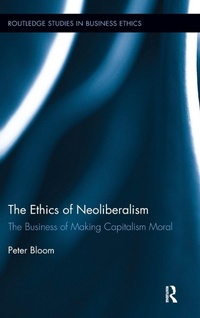
The Ethics of Neoliberalism
The Business of Making Capitalism Moral
1st Edition
Published on 15. June 2017
Book
Hardback
230 pages
978-1-138-66724-2 (ISBN)
Description
The 21st century is the age of "neo-liberalism" - a time when the free market is spreading to all areas of economic, political and social life. Yet how is this changing our individual and collective ethics? Is capitalism also becoming our new morality? From the growing popular demand for corporate social responsibility to personal desire for "work-life balance" it would appear that non-market ideals are not only surviving but also thriving. Why then does it seem that capitalism remains as strong as ever?
The Ethics of Neoliberalism boldly proposes that neoliberalism strategically co-opts traditional ethics to ideologically and structurally strengthen capitalism. It produces "the ethical capitalist subject" who is personally responsible for making their society, workplace and even their lives "more ethical" in the face of an immoral but seemingly permanent free market.
Rather than altering our morality, neoliberalism "individualizes" ethics, making us personally responsible for dealing with and resolving its moral failings. In doing so, individuals end up perpetuating the very market system that they morally oppose and feel powerless to ultimately change.
This analysis reveals the complex and paradoxical way capitalism is currently shaping us as "ethical subjects". People are increasingly asked to ethically "save" capitalism both collectively and personally. This can range from the "moral responsibility" to politically accept austerity following the financial crisis to the willingness of employees to sacrifice their time and energy to make their neoliberal organizations more "humane" to the efforts by individuals to contribute to their family and communities despite the pressures of a franetic global business environment. Neoliberalism, thus, uses our ethics against us, relying on our "good nature" and sense of personal responsibility to reduce its human cost in practice. Ironically
The Ethics of Neoliberalism boldly proposes that neoliberalism strategically co-opts traditional ethics to ideologically and structurally strengthen capitalism. It produces "the ethical capitalist subject" who is personally responsible for making their society, workplace and even their lives "more ethical" in the face of an immoral but seemingly permanent free market.
Rather than altering our morality, neoliberalism "individualizes" ethics, making us personally responsible for dealing with and resolving its moral failings. In doing so, individuals end up perpetuating the very market system that they morally oppose and feel powerless to ultimately change.
This analysis reveals the complex and paradoxical way capitalism is currently shaping us as "ethical subjects". People are increasingly asked to ethically "save" capitalism both collectively and personally. This can range from the "moral responsibility" to politically accept austerity following the financial crisis to the willingness of employees to sacrifice their time and energy to make their neoliberal organizations more "humane" to the efforts by individuals to contribute to their family and communities despite the pressures of a franetic global business environment. Neoliberalism, thus, uses our ethics against us, relying on our "good nature" and sense of personal responsibility to reduce its human cost in practice. Ironically
Reviews / Votes
"Neoliberalism has frequently been viewed as a nihilistic embrace of the free market or a governmental effort to reduce everything to economic calculation. Peter Bloom demonstrates that this representation misses vital dimensions of neoliberal power and ideology, namely the ways in which social and ethical life are co-opted in the service of economic institutions. Neoliberalism is not just an avenue to profit-maximisation, but promises "to allow subjects to use the market to be good and do good". The Ethics of Neoliberalism is an important new contribution to the field, which greatly enriches our understanding of how markets, ideology and morality become entangled, trapping us in the process."-- Dr. Will Davies. Reader in Political Economy, Goldsmith University of London, UKMore details
Series
Language
English
Place of publication
London
United Kingdom
Publishing group
Taylor & Francis Ltd
Target group
College/higher education
Dimensions
Height: 235 mm
Width: 157 mm
Thickness: 17 mm
Weight
490 gr
ISBN-13
978-1-138-66724-2 (9781138667242)
Copyright in bibliographic data and cover images is held by Nielsen Book Services Limited or by the publishers or by their respective licensors: all rights reserved.
Schweitzer Classification
Other editions
Additional editions

Book
06/2019
1st Edition
Routledge
€61.89
Shipment within 15-20 days
E-Book
06/2017
Routledge
€69.99
Available for download
E-Book
06/2017
Routledge
€69.99
Available for download
Person
Peter Bloom is a Lecturer in the Department of People and Organisations at the Open University, UK.
Content
1. The Paradox of Neoliberal Ethics
2. Producing the Ethical Capitalist Subject
3.The Ethical Power of Neoliberalism
4.The Political Power of Neoliberal Ethics
5.The Institutional Power of Neoliberal Ethics
6.The Personal Power of Neoliberal Ethics
7. The Subjective Power of Neoliberal Ethics
8.Fighting the Power of Neoliberal Ethics
9.The Ethics of Neoliberalism: The Business of Making Capitalism Moral
2. Producing the Ethical Capitalist Subject
3.The Ethical Power of Neoliberalism
4.The Political Power of Neoliberal Ethics
5.The Institutional Power of Neoliberal Ethics
6.The Personal Power of Neoliberal Ethics
7. The Subjective Power of Neoliberal Ethics
8.Fighting the Power of Neoliberal Ethics
9.The Ethics of Neoliberalism: The Business of Making Capitalism Moral