

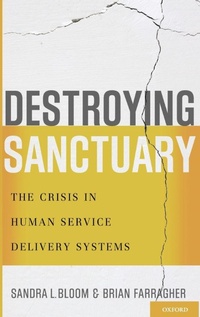
Destroying Sanctuary
The Crisis in Human Service Delivery Systems
1st Edition
Published on 18. November 2010
Book
Hardback
440 pages
978-0-19-537480-3 (ISBN)
Description
For the last thirty years, the nation's mental health and social service systems have been under relentless assault, with dramatically rising costs and the fragmentation of service delivery rendering them incapable of ensuring the safety, security, and recovery of their clients. The resulting organizational trauma both mirrors and magnifies the trauma-related problems their clients seek relief from. Just as the lives of people exposed to chronic trauma and abuse become organized around the traumatic experience, so too have our social service systems become organized around the recurrent stress of trying to do more under greater pressure: they become crisis-oriented, authoritarian, disempowered, and demoralized, often living in the present moment, haunted by the past, and unable to plan for the future.
Complex interactions among traumatized clients, stressed staff, pressured organizations, and a social and economic climate that is often hostile to recovery efforts recreate the very experiences that have proven so toxic to clients in the first place. Healing is possible for these clients if they enter helping, protective environments, yet toxic stress has destroyed the sanctuary that our systems are designed to provide.
This thoughtful, impassioned critique of business as usual begins to outline a vision for transforming our mental health and social service systems. Linking trauma theory to organizational function, Destroying Sanctuary provides a framework for creating truly trauma-informed services. The organizational change method that has become known as the Sanctuary Model lays the groundwork for establishing safe havens for individual and organizational recovery. The goals are practical: improve clinical outcomes, increase staff satisfaction and health, increase leadership competence, and develop a technology for creating and sustaining healthier systems. Only in this way can our mental health and social service systems become empowered to make a more effective contribution to the overall health of the nation.
Destroying Sanctuary is a stirring call for reform and recovery, required reading for anyone concerned with removing the formidable barriers to mental health and social services, from clinicians and administrators to consumer advocates.
Complex interactions among traumatized clients, stressed staff, pressured organizations, and a social and economic climate that is often hostile to recovery efforts recreate the very experiences that have proven so toxic to clients in the first place. Healing is possible for these clients if they enter helping, protective environments, yet toxic stress has destroyed the sanctuary that our systems are designed to provide.
This thoughtful, impassioned critique of business as usual begins to outline a vision for transforming our mental health and social service systems. Linking trauma theory to organizational function, Destroying Sanctuary provides a framework for creating truly trauma-informed services. The organizational change method that has become known as the Sanctuary Model lays the groundwork for establishing safe havens for individual and organizational recovery. The goals are practical: improve clinical outcomes, increase staff satisfaction and health, increase leadership competence, and develop a technology for creating and sustaining healthier systems. Only in this way can our mental health and social service systems become empowered to make a more effective contribution to the overall health of the nation.
Destroying Sanctuary is a stirring call for reform and recovery, required reading for anyone concerned with removing the formidable barriers to mental health and social services, from clinicians and administrators to consumer advocates.
More details
Language
English
Place of publication
New York
United States
Target group
Professional and scholarly
Mental health service providers and administrators; public health officials; mental health/social service agencies (for-profit, not-for-profit, and government); students in social work, psychology, counseling, psychiatry, and public health courses on service delivery issues, health & mental health policy, trauma, and clinical skills
Dimensions
Height: 240 mm
Width: 161 mm
Thickness: 28 mm
Weight
825 gr
ISBN-13
978-0-19-537480-3 (9780195374803)
Copyright in bibliographic data and cover images is held by Nielsen Book Services Limited or by the publishers or by their respective licensors: all rights reserved.
Schweitzer Classification
Other editions
Additional editions
Book
02/2013
Oxford University Press Inc
€79.40
Shipment within 15-20 days
E-Book
10/2010
1st Edition
OUP eBook
€40.99
Available for download
E-Book
10/2010
1st Edition
OUP eBook
€40.99
Available for download
Persons
Sandra L. Bloom, MD, is Associate Professor of Health Management and Policy, Drexel University School of Public Health and Past President, International Society for Traumatic Stress Studies.
Brian Farragher, MBA, is Executive Vice President and Chief Operating Officer, Andrus Children's Center.
Brian Farragher, MBA, is Executive Vice President and Chief Operating Officer, Andrus Children's Center.
Content
Prologue
Introduction
Chapter 1: Human Service Delivery Organizations: Dead or Alive?
Chapter 2: "I Gotta Get out of This Place": Workplace Stress as a Threat to Public Health
Chapter 3: When Terror Becomes a Way of Life
Chapter 4: Parallel Processes and Trauma-Organized Systems
Chapter 5: Lack of Basic Safety
Chapter 6: Loss of Emotional Management
Chapter 7: Organizational Learning Disabilities, Organizational Amnesia, and Decision-Making Under Stress
Chapter 8: Miscommunication, Conflict, and Organizational Alexithymia
Chapter 9: Authoritarianism, Disempowerment, and Learned Helplessness
Chapter 10: Punishment, Revenge, and Organizational Injustice
Chapter 11: Unresolved Grief, Reenactment, and Decline
Chapter 12: Restoring Sanctuary: Organizations as Living, Complex Adaptive Social Systems
References
Index
Introduction
Chapter 1: Human Service Delivery Organizations: Dead or Alive?
Chapter 2: "I Gotta Get out of This Place": Workplace Stress as a Threat to Public Health
Chapter 3: When Terror Becomes a Way of Life
Chapter 4: Parallel Processes and Trauma-Organized Systems
Chapter 5: Lack of Basic Safety
Chapter 6: Loss of Emotional Management
Chapter 7: Organizational Learning Disabilities, Organizational Amnesia, and Decision-Making Under Stress
Chapter 8: Miscommunication, Conflict, and Organizational Alexithymia
Chapter 9: Authoritarianism, Disempowerment, and Learned Helplessness
Chapter 10: Punishment, Revenge, and Organizational Injustice
Chapter 11: Unresolved Grief, Reenactment, and Decline
Chapter 12: Restoring Sanctuary: Organizations as Living, Complex Adaptive Social Systems
References
Index