

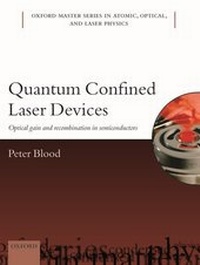
Quantum Confined Laser Devices
Optical gain and recombination in semiconductors
Published on 22. October 2015
Book
Hardback
432 pages
978-0-19-964451-3 (ISBN)
Description
The semiconductor laser, invented over 50 years ago, has had an enormous impact on the digital technologies that now dominate so many applications in business, commerce and the home. The laser is used in all types of optical fibre communication networks that enable the operation of the internet, e-mail, voice and skype transmission. Approximately one billion are produced each year for a market valued at around $5 billion. Nearly all semiconductor lasers now use
extremely thin layers of light emitting materials (quantum well lasers). Increasingly smaller nanostructures are used in the form of quantum dots. The impact of the semiconductor laser is surprising in the light of the complexity of the physical processes that determine the operation of every device.
This text takes the reader from the fundamental optical gain and carrier recombination processes in quantum wells and quantum dots, through descriptions of common device structures to an understanding of their operating characteristics. It has a consistent treatment of both quantum dot and quantum well structures taking full account of their dimensionality, which provides the reader with a complete account of contemporary quantum confined laser diodes. It includes plenty of illustrations from
both model calculations and experimental observations. There are numerous exercises, many designed to give a feel for values of key parameters and experience obtaining quantitative results from equations. Some challenging concepts, previously the subject matter of research monographs, are treated here
at this level for the first time.
extremely thin layers of light emitting materials (quantum well lasers). Increasingly smaller nanostructures are used in the form of quantum dots. The impact of the semiconductor laser is surprising in the light of the complexity of the physical processes that determine the operation of every device.
This text takes the reader from the fundamental optical gain and carrier recombination processes in quantum wells and quantum dots, through descriptions of common device structures to an understanding of their operating characteristics. It has a consistent treatment of both quantum dot and quantum well structures taking full account of their dimensionality, which provides the reader with a complete account of contemporary quantum confined laser diodes. It includes plenty of illustrations from
both model calculations and experimental observations. There are numerous exercises, many designed to give a feel for values of key parameters and experience obtaining quantitative results from equations. Some challenging concepts, previously the subject matter of research monographs, are treated here
at this level for the first time.
Reviews / Votes
Peter Blood's masterful account of semiconductor lasers is a very worthy addition to the Oxford Masters Series. The text captures the comprehensive knowledge of the author, and its particular focus on quantum confinement gives it a highly modern perspective. * Mark Fox, University of Sheffield * This is without doubt the most comprehensive publication on semiconductor lasers. It fulfils the role of being an excellent text book for students and a superb reference book that every laser physicist will want on their shelves. * Gareth Parry, Imperial College, London * This book is a clear, complete and wonderfully written text on quantum confined semiconductor lasers, authored by one of our senior and most respected colleagues. It will likely be your sole and primary reference for years to come. * James Coleman, University of Texas at Dallas * This volume provides a very readable account of the theory and practical implementation of recent advances in laser diode technology with emphasis on those incorporating quantum confined structures such as quantum wells and quantum dots. Students in the final year of an undergraduate course and those reading for a PhD in any aspect of laser physics, optoelectronics or semiconductor device physics and engineering will find here an invaluable source of up-to-dateinformation on this important field replete with exercises and detailed references to the literature. * Colin Webb MBE FRS, University of Oxford * This book is warmly welcomed as the first textbook devoted to quantum confined laser devices. Its author is a highly respected researcher who is also strongly committed to teaching. Now a wide audience can profit from the experience and expertise that Peter Blood has gained in researching and teaching semiconductor laser physics. * K. Alan Shore, Optics & Photonics News * This book is evidently written by an exceptional scientist with exceptional knowledge, a fact which is clearly visible to any reader. ... [T]his is an extraordinary book, which sets new standards. Everybody who deals with diode lasers on a level beyond pure applications should own this book, which I firmly recommend. * Jens W. Tomm, Journal of Applied Crystallography *
More details
Other editions
Additional editions
E-Book
10/2015
1st Edition
OUP eBook
€39.49
Available for download
Book
10/2015
Oxford University Press
€53.83
Shipment within 15-20 days
Person
Peter Blood received a PhD degree from the University of Leeds, UK and subsequently worked at Philips Research Laboratories, Redhill, UK on aspects of the electrical properties of semiconductors, spending some time as a visitor at Bell Laboratories at Murray Hill, NJ. Since 1983 he has been investigating the operation of semiconductor lasers and in 1990 he moved to the School of Physics and Astronomy in Cardiff University where the Group developed techniques for the
observation of spontaneous emission from laser diodes as a means of probing their steady-state and dynamic behaviour, and amplified spontaneous emission techniques for the measurement of absorption, gain and spontaneous emission. As well as giving undergraduate and postgraduate lectures courses on
laser diodes Peter Blood has given many short courses and review tutorials on quantum confined lasers at international conferences, including CLEO and the International Semiconductor Laser Conference.
observation of spontaneous emission from laser diodes as a means of probing their steady-state and dynamic behaviour, and amplified spontaneous emission techniques for the measurement of absorption, gain and spontaneous emission. As well as giving undergraduate and postgraduate lectures courses on
laser diodes Peter Blood has given many short courses and review tutorials on quantum confined lasers at international conferences, including CLEO and the International Semiconductor Laser Conference.
Content
PART I: THE DIODE LASER; PART II: FUNDAMENTAL PROCESSES; PART III: DEVICE PHYSICS; PART IV: DEVICE OPERATION; PART V: STUDIES OF GAIN AND RECOMBINATION