

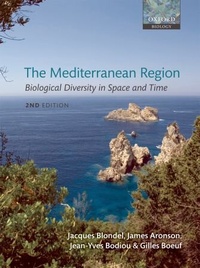
The Mediterranean Region
Biological Diversity in Space and Time
2nd Edition
Published on 28. January 2010
Book
Hardback
392 pages
978-0-19-955798-1 (ISBN)
Description
It is becoming clear that the Mediterranean region is one of the "hottest" of the biodiversity hotspots on the planet. There is also an increasing concern for the conservation, adaptive management, and restoration of the unique natural ecosystems and cultural landscapes that characterize this area. The region's biological and cultural heritage as well as its huge wealth of biodiversity is now at real risk. This brings a further urgency to the task of communicating
detailed but readily accessible information on the Mediterranean biota, and an ecological, historical and evolutionary perspective to the changing contexts in which the region's flora and fauna continue to evolve.
There is no other recent textbook devoted solely to Mediterranean evolutionary ecology, and a synthesis of the many recent advances is now overdue. This new work builds on the success and reputation of the first edition, although the text has been updated and expanded to document recent changes to biodiversity, new ecological and evolutionary insights, and the challenges for the future. These changes include the addition of two new chapters devoted to the Mediterranean Sea itself, and
especially the coastal areas. Throughout the book, the pressing issues of global change (especially climate warming) are addressed, in conjunction with changing land use, and in terms of their potential impact on biota, communities, ecosystems, and landscapes.
detailed but readily accessible information on the Mediterranean biota, and an ecological, historical and evolutionary perspective to the changing contexts in which the region's flora and fauna continue to evolve.
There is no other recent textbook devoted solely to Mediterranean evolutionary ecology, and a synthesis of the many recent advances is now overdue. This new work builds on the success and reputation of the first edition, although the text has been updated and expanded to document recent changes to biodiversity, new ecological and evolutionary insights, and the challenges for the future. These changes include the addition of two new chapters devoted to the Mediterranean Sea itself, and
especially the coastal areas. Throughout the book, the pressing issues of global change (especially climate warming) are addressed, in conjunction with changing land use, and in terms of their potential impact on biota, communities, ecosystems, and landscapes.
More details
Edition
2nd Revised edition
Language
English
Place of publication
Oxford
United Kingdom
Target group
College/higher education
Professional and scholarly
Edition type
Revised edition
Illustrations
60 black and white illustrations plus an 8 page colour plate section
Dimensions
Height: 252 mm
Width: 195 mm
Thickness: 25 mm
Weight
1040 gr
ISBN-13
978-0-19-955798-1 (9780199557981)
Copyright in bibliographic data and cover images is held by Nielsen Book Services Limited or by the publishers or by their respective licensors: all rights reserved.
Schweitzer Classification
Other editions
Additional editions
E-Book
01/2010
1st Edition
OUP
€123.27
Available for download
Jacques Blondel | James Aronson | Jean-Yves Bodiou
The Mediterranean Region
Biological Diversity in Space and Time
Book
01/2010
2nd Edition
Oxford University Press
€95.32
Shipment within 15-20 days
Persons
Jacques BLONDEL is emeritus Director of research at the Center of Functional and Evolutionary Ecology (CNRS) in Montpellier, France. He is involved in studies on biogeography, community ecology and population biology at various scales of space and time, using birds as study models. He has published extensively on these fields in the last 45 years. He has been deeply involved in conservation biology in France and the EU, including serving as President of the European
Ornithologists' Union and the 24th International Congress of Ornithology and as President of the Scientific Commission of the French Institute for Biodiversity. He is also member of the Scientific Committee of the Natural Patrimony and Biodiversity of the French Ministry of Ecology and Sustainable
Development.
James ARONSON is a researcher at the Center of Functional and Evolutionary Ecology (CNRS) in Montpellier, France and head of the Restoration Ecology group at the Missouri Botanical Garden, USA. He works on the restoration of degraded ecosystems in many parts of the world. He is editor of the book series "Science and Practice of Ecological Restoration", published by the Society for Ecological Restoration International and Island Press.
Jean-Yves BODIOU is Assistant Professor at the Laboratoire Arago in Banyuls-sur-mer, France. He works on the marine Meiobenthos, particularly the Harpacticoid Copepods. He teaches Marine Biology and Ecology of the Benthos. For 25 years he served as curator of the public aquarium of Banyuls-sur-mer.
Gilles BOEUF is Professor at the University Pierre et Marie Curie, Paris 6 (UPMC), France. He is presently the head of the combined Laboratory UPMC/CNRS "Models in Cellular and Evolutive Biology" at the Oceanological Observatory, located involved in studies on environmental physiology, comparative endocrinology, ocean living resources and marine biodiversity. He mainly works on fish, as models. He has published extensively on these fields over the last 33 years. He is deeply involved in
comparative physiology and biodiversity studies, including serving as President of the Scientific Committee of the National Museum of Natural History and member of the Scientific Committee of the Natural Patrimony and Biodiversity of the French Ministry of Ecology and Sustainable
Development.
Ornithologists' Union and the 24th International Congress of Ornithology and as President of the Scientific Commission of the French Institute for Biodiversity. He is also member of the Scientific Committee of the Natural Patrimony and Biodiversity of the French Ministry of Ecology and Sustainable
Development.
James ARONSON is a researcher at the Center of Functional and Evolutionary Ecology (CNRS) in Montpellier, France and head of the Restoration Ecology group at the Missouri Botanical Garden, USA. He works on the restoration of degraded ecosystems in many parts of the world. He is editor of the book series "Science and Practice of Ecological Restoration", published by the Society for Ecological Restoration International and Island Press.
Jean-Yves BODIOU is Assistant Professor at the Laboratoire Arago in Banyuls-sur-mer, France. He works on the marine Meiobenthos, particularly the Harpacticoid Copepods. He teaches Marine Biology and Ecology of the Benthos. For 25 years he served as curator of the public aquarium of Banyuls-sur-mer.
Gilles BOEUF is Professor at the University Pierre et Marie Curie, Paris 6 (UPMC), France. He is presently the head of the combined Laboratory UPMC/CNRS "Models in Cellular and Evolutive Biology" at the Oceanological Observatory, located involved in studies on environmental physiology, comparative endocrinology, ocean living resources and marine biodiversity. He mainly works on fish, as models. He has published extensively on these fields over the last 33 years. He is deeply involved in
comparative physiology and biodiversity studies, including serving as President of the Scientific Committee of the National Museum of Natural History and member of the Scientific Committee of the Natural Patrimony and Biodiversity of the French Ministry of Ecology and Sustainable
Development.
Content
Foreword ; Preface ; 1. Setting the Scene ; 2. Determinants of Present-Day Biodiversity ; 3. Present-Day Terrestrial Biodiversity ; 4. Present-Day Marine Biodiversity ; 5. Scales of Observation ; 6. A Patchwork of Habitats ; 7. Populations, Species, and Community Variations ; 8. Life Histories and Terrestrial Ecosystem Functioning ; 9. Life in the Sea ; 10. Humans as Sculptors of Mediterranean Landscapes ; 11. Biodiversity Downs and Ups ; 12. Biodiversity and Global Change ; 13. Challenges for the Future ; Glossary ; References ; Index