


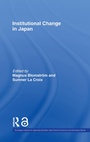
Institutional Change in Japan
Published on 4. May 2006
Book
Hardback
254 pages
978-0-415-38015-7 (ISBN)
Description
This is a new analysis of recent changes in important Japanese institutions. It addresses the origin, development, and recent adaptation of core institutions, including financial institutions, corporate governance, lifetime employment, and the amakudari system.
After four decades of rapid economic growth in Japan, the 1990s saw the country enter a prolonged period of economic stagnation. Policy reforms were initially half-hearted, and businesses were slow to restructure as the global economy changed. The lagging economy has been impervious to aggressive fiscal stimulus measures and has been plagued by ongoing price deflation for years. Japan's struggle has called into question the ability of the country's economic institutions, originally designed to support factor accumulation and rapid development, to adapt to the new economic environment of the twenty-first century.
This book discusses both historical and international comparisons including Meiji Japan, and recent economic and financial reforms in Korea, Scandinavia, Switzerland, and New Zealand, placing the current institutional changes in perspective. The contributors argue that, contrary to conventional wisdom that Japanese institutions have remained relatively rigid, there has been significant institutional change over the last decade.
After four decades of rapid economic growth in Japan, the 1990s saw the country enter a prolonged period of economic stagnation. Policy reforms were initially half-hearted, and businesses were slow to restructure as the global economy changed. The lagging economy has been impervious to aggressive fiscal stimulus measures and has been plagued by ongoing price deflation for years. Japan's struggle has called into question the ability of the country's economic institutions, originally designed to support factor accumulation and rapid development, to adapt to the new economic environment of the twenty-first century.
This book discusses both historical and international comparisons including Meiji Japan, and recent economic and financial reforms in Korea, Scandinavia, Switzerland, and New Zealand, placing the current institutional changes in perspective. The contributors argue that, contrary to conventional wisdom that Japanese institutions have remained relatively rigid, there has been significant institutional change over the last decade.
More details
Series
Language
English
Place of publication
London
United Kingdom
Publishing group
Taylor & Francis Ltd
Target group
College/higher education
Illustrations
11 s/w Zeichnungen, 10 s/w Tabellen
10 Tables, black and white; 11 Line drawings, black and white
Dimensions
Height: 240 mm
Width: 161 mm
Thickness: 18 mm
Weight
552 gr
ISBN-13
978-0-415-38015-7 (9780415380157)
Copyright in bibliographic data and cover images is held by Nielsen Book Services Limited or by the publishers or by their respective licensors: all rights reserved.
Schweitzer Classification
Other editions
Additional editions

Magnus Blomstroem | Sumner La Croix
Institutional Change in Japan
Book
03/2013
Routledge
€54.66
The article will not be published

Magnus Blomstroem | Sumner La Croix
Institutional Change in Japan
Book
03/2012
Routledge
€71.50
Shipment within 15-20 days
Magnus Blomstroem | Sumner La Croix
Institutional Change in Japan
E-Book
08/2006
Routledge
€0.00
Available for download
Magnus Blomstroem | Sumner La Croix
Institutional Change in Japan
E-Book
08/2006
Routledge
€0.00
Available for download
Persons
Magnus Blomstroem is Professor of Economics at the Stockholm School of Economics and President of the European Institute of Japanese Studies.
Sumner La Croix is Professor of Economics at the University of Hawaii-Manoa, USA.
Sumner La Croix is Professor of Economics at the University of Hawaii-Manoa, USA.
Content
Introduction Part 1: Institutional Change in Theory and Practice 1. Theories of Institutional Change: How Well Do They Apply to Japan? 2. Institutional Revolution: The Case of Meiji Japan 3. Institutional Reform in Japan and Korea: Why the Difference? Part 2: Japanese Institutions: What Has Changed, What Has Not, and Why 4. A Lost Decade For Corporate Governance? What's Changed, What Hasn't, and Why 5. Japan's Economic and Financial Stagnation in the 1990s and Reluctance to Change 6. Life-Time Employment: History and Response to Crisis 7. The Japanese Labour Movement and Institutional Reform 8. Is Amakudari Changing? The Case of Regional Banks 9. Divorce In Japan: Why It Happens, Why It Doesn't