

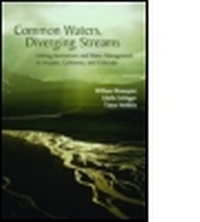
Common Waters, Diverging Streams
Linking Institutions and Water Management in Arizona, California, and Colorado
1st Edition
Published on 21. April 2004
Book
Hardback
216 pages
978-1-891853-83-8 (ISBN)
Description
This book is a firsthand investigation into water management in a fast-growing region of the arid American West. It presents three states that have adopted the conjunctive management of groundwater and surface water to make resources go further in serving people and the environment. Yet conjunctive management has followed a different history, been practiced differently, and produced different outcomes in each state. The authors question why different results have emerged from neighbors trying to solve similar problems with the same policy reform. Common Waters, Diverging Streams makes several important contributions to policy literature and policymaking. The first book on conjunctive water management, it describes how the policy came into existence, how it is practiced, what it does and does not accomplish, and how institutional arrangements affect its application. A second contribution is the book's clear and persuasive links between institutions and policy outcomes. Scholars often declare that institutions matter, but few articles or books provide an explicit case study of how policy linkages work in actual practice. In contrast, Blomquist, Schlager, and Heikkila show how diverging courses in conjunctive water management can be explained by state laws and regulations, legal doctrines, the organizations governing and managing water supplies, and the division of authority between state and local government. Not only do these institutional structures make conjunctive management easier or harder to achieve, but they influence the kinds of problems people try to solve and the purposes for which they attempt conjunctive management.
Reviews / Votes
'Provides a good look at how institutions play a part in shaping policies and how these policies are implemented, making the work a solid resource for anyone wishing to explore the complexities of public policy and management through the lens of western water management.'Perspectives on Politics, APSA
'A timely and informative study of conjunctive water management at a time of increasingly scarce water resources. . . . A thoroughly researched, well-presented, and thoughtful analysis of the history and future of recharge and recovery of surplus surface water in three western states.'
Southwest Hydrology
More details
Language
English
Place of publication
Washington
United States
Publishing group
Taylor & Francis Inc
Target group
College/higher education
Professional and scholarly
Dimensions
Height: 229 mm
Width: 152 mm
Weight
512 gr
ISBN-13
978-1-891853-83-8 (9781891853838)
Copyright in bibliographic data and cover images is held by Nielsen Book Services Limited or by the publishers or by their respective licensors: all rights reserved.
Schweitzer Classification
Other editions
Additional editions
William Blomquist | Edella Schlager | Tanya Heikkila
Common Waters, Diverging Streams
Linking Institutions and Water Management in Arizona, California, and Colorado
E-Book
09/2010
1st Edition
Routledge
€52.49
Available for download
William Blomquist | Edella Schlager | Tanya Heikkila
Common Waters, Diverging Streams
Linking Institutions and Water Management in Arizona, California, and Colorado
E-Book
09/2010
1st Edition
Routledge
€52.49
Available for download
William Blomquist | Edella Schlager | Tanya Heikkila
Common Waters, Diverging Streams
Linking Institutions and Water Management in Arizona, California, and Colorado
Book
04/2004
1st Edition
Resources for the Future Press (RFF Press)
€60.10
Shipment within 3-4 weeks
Persons
William Blomquist is an associate professor of political science at Indiana University Purdue University Indianapolis (IUPUI), and is a member of the Research Advisory Board of the National Water Research Institute. His previous publications include Dividing the Waters: Governing Groundwater in Southern California.
Edella Schlager is an associate professor in the School of Public Administration and Policy at the University of Arizona. She has recently published articles in Natural Resources Journal and the American Behavioral Scientist.
Tanya Heikkila is an assistant professor with Columbia University?s MPA program in Environmental Science and Policy in the School of International and Public Affairs. She has recently published articles in Natural Resources Journal (with Schlager and Blomquist) and the Journal of Policy Analysis and Management.
Edella Schlager is an associate professor in the School of Public Administration and Policy at the University of Arizona. She has recently published articles in Natural Resources Journal and the American Behavioral Scientist.
Tanya Heikkila is an assistant professor with Columbia University?s MPA program in Environmental Science and Policy in the School of International and Public Affairs. She has recently published articles in Natural Resources Journal (with Schlager and Blomquist) and the Journal of Policy Analysis and Management.
Content
Preface
PART 1
Common Waters: Managing Surface Water and Groundwater Resources Together
1. Water Scarcity, Management, and Institutions
2. The Promise of Conjunctive Water Management
3. Opportunities and Obstacles for Conjunctive Management
PART 2
How Institutions Matter: Institutions and Conjunctive Management in California, Arizona, and Colorado
4. California
5. Arizona
6. Colorado
PART 3
Institutions and Policy Change: Analysis and Recommendations
7. Tracing and Comparing Institutional Effects
8. Future Directions of the Diverging Streams
9. Shaping the Future: Institutional Changes to Improve Water Management
Appendix. The Three States: Why We Chose Them, and What We Did
Notes
Bibliography
Index
PART 1
Common Waters: Managing Surface Water and Groundwater Resources Together
1. Water Scarcity, Management, and Institutions
2. The Promise of Conjunctive Water Management
3. Opportunities and Obstacles for Conjunctive Management
PART 2
How Institutions Matter: Institutions and Conjunctive Management in California, Arizona, and Colorado
4. California
5. Arizona
6. Colorado
PART 3
Institutions and Policy Change: Analysis and Recommendations
7. Tracing and Comparing Institutional Effects
8. Future Directions of the Diverging Streams
9. Shaping the Future: Institutional Changes to Improve Water Management
Appendix. The Three States: Why We Chose Them, and What We Did
Notes
Bibliography
Index