

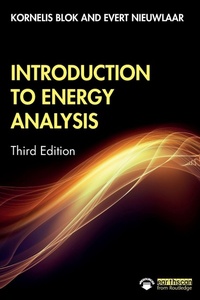
Introduction to Energy Analysis
3rd Edition
Published on 18. November 2020
Book
Paperback/Softback
348 pages
978-0-367-43481-6 (ISBN)
Description
This textbook provides an introduction to energy analysis for those students who want to specialise in this challenging field.
In comparison to other textbooks, this book provides a balanced treatment of complete energy systems, covering the demand side, the supply side, and the energy markets that connect these. The emphasis is very much on presenting a range of tools and methodologies that will help students find their way in analysing real world problems in energy systems. This new edition has been updated throughout and contains additional content on energy transitions and improvements in the treatment of several energy systems analysis approaches.
Featuring learning objectives, further readings and practical exercises in each chapter, Introduction to Energy Analysis will be essential reading for upper-level undergraduate and postgraduate students with a background in the natural sciences and engineering. This book may also be useful for professionals dealing with energy issues, as a first introduction into the field.
In comparison to other textbooks, this book provides a balanced treatment of complete energy systems, covering the demand side, the supply side, and the energy markets that connect these. The emphasis is very much on presenting a range of tools and methodologies that will help students find their way in analysing real world problems in energy systems. This new edition has been updated throughout and contains additional content on energy transitions and improvements in the treatment of several energy systems analysis approaches.
Featuring learning objectives, further readings and practical exercises in each chapter, Introduction to Energy Analysis will be essential reading for upper-level undergraduate and postgraduate students with a background in the natural sciences and engineering. This book may also be useful for professionals dealing with energy issues, as a first introduction into the field.
Reviews / Votes
"This book offers a broad overview of topics in energy analysis, and is very suitable for beginners in this field of science. It contains a large variety of exercises, making it a valuable resource for students to study the content and test their understanding in their own time and at their own pace."Wilfried Ivens, Associate Professor at Open Universiteit Nederland
Praise for the second edition
"Introduction to Energy Analysis provides a wonderful combination of technical detail and broad accessibility to the physical science and economics principles of energy systems design, operation, and impacts. With the exciting evolution of the energy field this is the sort of roadmap to the principles underlying the field that so many experts and non-experts will need."
Daniel Kammen, Professor of Energy, University of California, Berkeley, USA
"Given the rapid developments in the energy sector, Introduction to Energy Analysis by Blok and Nieuwlaar is most welcome. The book is suitable for students, engineers and researchers and is hugely useful in my class on Energy System Analysis at ETH Zurich."
Goeran Andersson, Full Professor of the Power Systems Group at ETH Zurich, Switzerland
"[In this updated edition] Blok and Nieuwlaar provide an excellent, clear and concise overview and introduction to the key aspects of energy analysis. It is the ultimate and unparalleled textbook for engineering students and others who look for a broad understanding of energy systems, their development, and the methods and tools for their analysis."
Lars J. Nilsson, Professor of Environmental and Energy Systems Studies, Lund University, Sweden
More details
Edition
3rd edition
Language
English
Place of publication
London
United Kingdom
Publishing group
Taylor & Francis Ltd
Target group
College/higher education
Professional and scholarly
Illustrations
88 s/w Abbildungen, 88 s/w Zeichnungen, 76 s/w Tabellen
76 Tables, black and white; 88 Line drawings, black and white; 88 Illustrations, black and white
Dimensions
Height: 234 mm
Width: 156 mm
Thickness: 21 mm
Weight
579 gr
ISBN-13
978-0-367-43481-6 (9780367434816)
Copyright in bibliographic data and cover images is held by Nielsen Book Services Limited or by the publishers or by their respective licensors: all rights reserved.
Schweitzer Classification
Other editions
Additional editions
Kornelis Blok | Evert Nieuwlaar
Introduction to Energy Analysis
Book
11/2020
3rd Edition
Routledge
€207.30
Shipment within 15-20 days
Kornelis Blok | Evert Nieuwlaar
Introduction to Energy Analysis
E-Book
11/2020
3rd Edition
Routledge
€59.49
Available for download
Kornelis Blok | Evert Nieuwlaar
Introduction to Energy Analysis
E-Book
11/2020
3rd Edition
Routledge
€59.49
Available for download
Previous edition
Kornelis Blok | Evert Nieuwlaar
Introduction to Energy Analysis
Book
09/2016
2nd Edition
Routledge
€74.46
Withdrawn from sale
Persons
Kornelis Blok holds a Chair in Energy Systems Analysis at Delft University of Technology, the Netherlands, where he is also chairman of the Delft Energy Initiative. He has authored and co-authored over 100 articles in peer-reviewed scientific journals, several books and 250 research reports, conference contributions and other scientific publications. He was and is a lead author for the Third, Fourth and Sixth Assessment Reports of the Intergovernmental Panel on Climate Change, the organisation that was awarded the Nobel Peace Prize in 2007.
Evert Nieuwlaar is retired Assistant Professor of Energy Analysis at the Copernicus Institute of Sustainable Development, Utrecht University, the Netherlands. He has long experience in research and education in the field of energy, environmental and sustainability issues. He taught courses in thermodynamics, energy conversion technologies, energy analysis (introductory and advanced) and life-cycle assessment.
Evert Nieuwlaar is retired Assistant Professor of Energy Analysis at the Copernicus Institute of Sustainable Development, Utrecht University, the Netherlands. He has long experience in research and education in the field of energy, environmental and sustainability issues. He taught courses in thermodynamics, energy conversion technologies, energy analysis (introductory and advanced) and life-cycle assessment.
Content
1. Energy and Society 2. What is Energy? 3. Energy Services and Energy Demand 4. Energy Use in Industry, Analysis and Management of Energy Use 5. Energy Extraction and Conversion 6. Energy Markets 7. Exergy Analysis 8. Analysis of Energy Chains 9. Life-Cycle Energy Analysis 10. Energy Efficiency 11. Economic Analysis of Energy Technologies 12. Potentials and Marginal Abatement Cost Curves 13. Volume, Structure and Energy Efficiency 14. Energy Policies and Policy Evaluation 15. Energy Models and Energy Scenarios 16. Climate-Neutral Energy Systems