

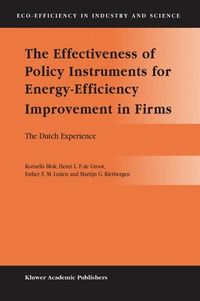
The Effectiveness of Policy Instruments for Energy-Efficiency Improvement in Firms
The Dutch Experience
Published on 31. May 2004
Book
Hardback
XI, 197 pages
978-1-4020-1965-4 (ISBN)
Description
Improvement of energy efficiency is one of the important options for reducing greenhouse gas emissions. According to the Third Assessment Report of the Intergovernmental Panel on Climate Change, hundreds of technologies for improving the end-use energy efficiency make up more than half of the global potential for greenhouse gas emission reduction in the short and medium term (2010 -2020). (IPCC, 2001; see also WEA, 2000). An important next question is how these options can actually be deployed. More specifically, one may ask what role governments can play by using policy instruments to promote the deployment of energy efficient technologies. In this introductory Chapter, we will first set out the aim of the research described in this book. Then we will discuss the various policy instruments that may playa role in energy-efficiency improvement. Next the various aspects important for characterising policy instruments will be discussed and the various disciplinary approaches are listed. Finally, the outline of the complete book will be given.
More details
Series
Edition
2004 ed.
Language
English
Place of publication
Dordrecht
Netherlands
Target group
Professional and scholarly
Research
Illustrations
XI, 197 p.
Dimensions
Height: 241 mm
Width: 160 mm
Thickness: 18 mm
Weight
489 gr
ISBN-13
978-1-4020-1965-4 (9781402019654)
DOI
10.1007/978-1-4020-2157-2
Schweitzer Classification
Other editions
Additional editions
Kornelis Blok | Henri L.F. de Groot | Esther E.M. Luiten
The Effectiveness of Policy Instruments for Energy-Efficiency Improvement in Firms
The Dutch Experience
Book
12/2010
Springer
€106.99
Shipment within 15-20 days
Kornelis Blok | Henri L.F. de Groot | Esther E.M. Luiten
The Effectiveness of Policy Instruments for Energy-Efficiency Improvement in Firms
The Dutch Experience
E-Book
03/2004
Springer
€96.29
Available for download
Content
1 Introduction.- 2 A Framework for Analysing the Adoption of Energy-Efficient Technologies.- 3 Subsidising the Adoption of Energy-Efficient Technologies: An Empirical Analysis of the Free-Rider Effect.- 4 Energy-Efficiency Standards.- 5 Negotiated Agreements.- 6 Government Intervention Strategies in Stimulating the R&D of Energy-Efficient Technologies.- 7 Instrument Choice and Energy-Efficiency Improvement by Firms: An Empirical Analysis.- 8 Policy Instruments for Technology Adoption: A Model for Analysing the Diffusion of Energy-Efficient Technologies.- 9 Conclusions.- References.- Appendix I.- Appendix II.