

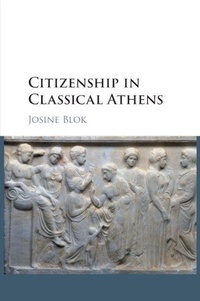
Citizenship in Classical Athens
Published on 12. December 2019
Book
Paperback/Softback
350 pages
978-1-108-70243-0 (ISBN)
Description
What did citizenship really mean in classical Athens? It is conventionally understood as characterised by holding political office. Since only men could do so, only they were considered to be citizens, and the community (polis) has appeared primarily as the scene of men's political actions. However, Athenian law defined citizens not by political office, but by descent. Religion was central to the polis and in this domain, women played prominent public roles. Both men and women were called 'citizens'. On a new reading of the evidence, Josine Blok argues that for the Athenians, their polis was founded on an enduring bond with the gods. Laws anchored the polis' commitments to humans and gods in this bond, transmitted over time to male and female Athenians as equal heirs. All public offices, in various ways and as befitting gender and age, served both the human community and the divine powers protecting Athens.
More details
Language
English
Place of publication
Cambridge
United Kingdom
Target group
Professional and scholarly
Product notice
Paperback (trade)
Illustrations
Worked examples or Exercises
Dimensions
Height: 229 mm
Width: 152 mm
Thickness: 19 mm
Weight
508 gr
ISBN-13
978-1-108-70243-0 (9781108702430)
Copyright in bibliographic data and cover images is held by Nielsen Book Services Limited or by the publishers or by their respective licensors: all rights reserved.
Schweitzer Classification
Other editions
Additional editions
Josine Blok
Citizenship in Classical Athens
Book
03/2017
Cambridge University Press
€129.90
Shipment within 15-20 days
Person
Josine Blok is Professor of Ancient History and Classical Civilization at Universiteit Utrecht, The Netherlands and a member of the Royal Dutch Academy of Sciences. She has won wide acclaim for her innovative work on archaic and classical Greece, notably on the Greek polis, and is a winner of the prestigious VICI-award for groundbreaking research issued by the Netherlands Organisation for Scientific Research. She has been a Visiting Fellow at various universities including the University of Oxford and Paris Sorbonne, and is the founder and current chair of the European Network for the Study of Ancient Greek History.
Content
1. Rethinking Athenian citizenship; 2. A bond between polis and gods; 3. The value of descent; 4. Citizens, male and female: vocabulary; 5. Participation: public roles and institutions; 6. Outlook: Athenians and others.