

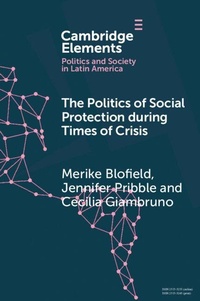
The Politics of Social Protection During Times of Crisis
Published on 3. August 2023
Book
Paperback/Softback
88 pages
978-1-009-41601-6 (ISBN)
Description
In 2020, as Latin American countries shuttered their economies, it became clear that effective lockdowns would require states to provide income support. In a region that has historically struggled to build systems of social protection, the effort to expand benefits was notable. Policies varied in scope and generosity, but in what seemed to signify a new era of state-building, Latin American democracies demonstrated a nearly uniform commitment to providing assistance to the poor. Why did some countries implement broader and more adequate programs than others and why did countries vary in their ability to sustain support over time? This Element argues that three factors explain cross-national and cross-temporal differences in policy effort: policy legacies, unified/divided government, and fiscal space. The study shows that in settings of crisis, the democratic politics of social policy expansion shift, with traditional factors like ideology and electoral competition playing a less central role.
More details
Series
Language
English
Place of publication
Cambridge
United Kingdom
Product notice
Paperback (trade)
Illustrations
Worked examples or Exercises
Dimensions
Height: 229 mm
Width: 152 mm
Thickness: 5 mm
Weight
127 gr
ISBN-13
978-1-009-41601-6 (9781009416016)
Copyright in bibliographic data and cover images is held by Nielsen Book Services Limited or by the publishers or by their respective licensors: all rights reserved.
Schweitzer Classification
Other editions
Additional editions
Merike Blofield | Jennifer Pribble | Cecilia Giambruno
The Politics of Social Protection During Times of Crisis
E-Book
07/2023
Cambridge University Press
€20.99
Available for download
Persons
Content
1. Explaining social protection during times of crisis; 2. Existing literature and theoretical expectations; 3. How did Latin American states respond to the crisis?; 4. Comparing the cash transfer policy response of seven countries: the effect of policy legacies, fiscal space, and divided government; 5. Policy making in times of crisis - lessons from the COVID-19 experience; References.