

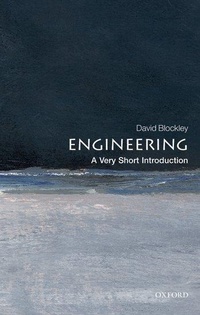
Engineering
A Very Short Introduction
1st Edition
Published on 22. March 2012
Book
Paperback/Softback
160 pages
978-0-19-957869-6 (ISBN)
Description
Engineering is part of almost everything we do - from the water we drink and the food we eat, to the buildings we live in and the roads and railways we travel on. In this Very Short Introduction, David Blockley explores the nature and practice of engineering, its history, its scope, and its relationship with art, craft, science, and technology. He considers the role of engineering in the modern world, demonstrating its need to provide both practical and socially acceptable solutions, and explores how engineers use natural phenomena to embrace human needs.
From its early roots starting with Archimedes to some of the great figures of engineering such as Brunel and Marconi, right up to the modern day, he also looks at some of its challenges - when things go wrong - such as at Chernobyl. Ultimately, he shows how engineering is intimately part of who and what we are.
ABOUT THE SERIES: The Very Short Introductions series from Oxford University Press contains hundreds of titles in almost every subject area. These pocket-sized books are the perfect way to get ahead in a new subject quickly. Our expert authors combine facts, analysis, perspective, new ideas, and enthusiasm to make interesting and challenging topics highly readable.
From its early roots starting with Archimedes to some of the great figures of engineering such as Brunel and Marconi, right up to the modern day, he also looks at some of its challenges - when things go wrong - such as at Chernobyl. Ultimately, he shows how engineering is intimately part of who and what we are.
ABOUT THE SERIES: The Very Short Introductions series from Oxford University Press contains hundreds of titles in almost every subject area. These pocket-sized books are the perfect way to get ahead in a new subject quickly. Our expert authors combine facts, analysis, perspective, new ideas, and enthusiasm to make interesting and challenging topics highly readable.
Reviews / Votes
Any engineer who has spent a few years out of the classroom can benefit from reading this tiny volume as a refresher course on some basic, yet key, concepts of engineering * The Tech * This concise book provides excellent references for further reading and is an affordable, quick read to brush up on engineering history and its modern-day application. It is even more powerful as a tool for non-engineers to understand how intimately engineering contributes to the quality of peoples' lives - and the consequences of success or failure. * Civil Engineering Journal *More details
Series
Language
English
Place of publication
Oxford
United Kingdom
Target group
Students of engineering courses and general readers who wish to gain an appreciation of engineering, science, and technology.
Illustrations
Approx 20 black and white illustrations
Dimensions
Height: 181 mm
Width: 113 mm
Thickness: 15 mm
Weight
120 gr
ISBN-13
978-0-19-957869-6 (9780199578696)
Copyright in bibliographic data and cover images is held by Nielsen Book Services Limited or by the publishers or by their respective licensors: all rights reserved.
Schweitzer Classification
Other editions
Additional editions
E-Book
03/2012
1st Edition
OUP Oxford
€15.89
Available for download
E-Book
03/2012
1st Edition
Oxford University Press
€8.99
Available for download
Person
Professor Blockley is an engineer and an academic scientist. He has been Head of the Department of Civil Engineering and Dean of the Faculty of Engineering at the University of Bristol. He is a Fellow of the Royal Academy of Engineering, the Institution of Civil Engineers, the Institution of Structural Engineers, and the Royal Society of Arts. He has written four other books including The Penguin Dictionary of Civil Engineering (2005).
Content
1. From idea to reality ; 2. The age of gravity - time for work ; 3. The age of heat - you can't get something for nothing ; 4. The age of electromagnetism - the power of attraction ; 5. The age of information - getting smaller ; 6. The age of systems - risky futures ; Glossary ; Further reading