

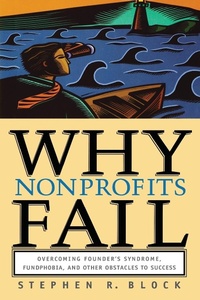
Why Nonprofits Fail
Overcoming Founder's Syndrome, Fundphobia and Other Obstacles to Success
1st Edition
Published on 27. February 2013
Book
Paperback/Softback
208 pages
978-1-118-64207-8 (ISBN)
Description
In Why Nonprofits Fail, author and nonprofit expert Stephen Block explains that many well-intentioned leaders hold on to views of their nonprofit organizations that perpetuate problems rather than help fix them. According to Block, the first step to success is to challenge one's own personal paradigms and ideas and be open to unique and alternative approaches to solving problems. This much-needed book helps nonprofits get back on track and offers advice about the seven most common stumbling blocks, including: Founder's syndrome Fundphobia Financial misfortune Recruitment disorientation Cultural depression in nonprofit organizations Self-serving political performance Role confusion between the board and executive director
More details
Language
English
Place of publication
New York
United States
Target group
Professional and scholarly
Product notice
Paperback (trade)
Unsewn / adhesive bound
Dimensions
Height: 229 mm
Width: 152 mm
Thickness: 12 mm
Weight
312 gr
ISBN-13
978-1-118-64207-8 (9781118642078)
Copyright in bibliographic data and cover images is held by Nielsen Book Services Limited or by the publishers or by their respective licensors: all rights reserved.
Schweitzer Classification
Other editions
Additional editions
Stephen R. Block
Why Nonprofits Fail
Overcoming Founder's Syndrome, Fundphobia and Other Obstacles to Success
E-Book
07/2004
Jossey-Bass
€21.99
Available for download

Stephen R. Block
Why Nonprofits Fail
Overcoming Founder's Syndrome, Fund-phobia and Other Obstacles to Success
Book
12/2003
Jossey-Bass
€44.75
Article exhausted; check different version
Person
Stephen R. Block is the founding executive director of
Denver Options, Inc., a nonprofit organization that manages the
developmental disabilities service delivery system of care in
Denver. He is the director of the Nonprofit Management Program at
the University of Colorado at Denver?s Graduate School of
Public Affairs. Block was a consulting editor for the Nonprofit
and Voluntary Sector Quarterly and on the editorial board of
the Journal of Vocational Rehabilitation.
Denver Options, Inc., a nonprofit organization that manages the
developmental disabilities service delivery system of care in
Denver. He is the director of the Nonprofit Management Program at
the University of Colorado at Denver?s Graduate School of
Public Affairs. Block was a consulting editor for the Nonprofit
and Voluntary Sector Quarterly and on the editorial board of
the Journal of Vocational Rehabilitation.
Content
Preface ix
Acknowledgments xv
The Author xvii
Part I: Charting a New Path to Success
1. Preventing Failure, Ensuring Success 3
2. The Need for Alternative Tools 13
3. The Framework and the Steps 21
4. First-Order and Second-Order Approaches to Change 27
Part II: Seven Tough Problems and How to Solve Them
5. Recruitment Disorientation 41
6. Cultural Depression in Nonprofit Organizations 59
7. Political Performance 73
8. Role Confusion 91
9. Financial Misfortune 107
10. Fundphobia 121
11. Founder's Syndrome 135
Conclusion: Managing Nonprofit Organizational Change 155
Resource A: A Review of Organizational Behavior Theories 161
Resource B: Recommended Reading 179
References 181
Index 185
Acknowledgments xv
The Author xvii
Part I: Charting a New Path to Success
1. Preventing Failure, Ensuring Success 3
2. The Need for Alternative Tools 13
3. The Framework and the Steps 21
4. First-Order and Second-Order Approaches to Change 27
Part II: Seven Tough Problems and How to Solve Them
5. Recruitment Disorientation 41
6. Cultural Depression in Nonprofit Organizations 59
7. Political Performance 73
8. Role Confusion 91
9. Financial Misfortune 107
10. Fundphobia 121
11. Founder's Syndrome 135
Conclusion: Managing Nonprofit Organizational Change 155
Resource A: A Review of Organizational Behavior Theories 161
Resource B: Recommended Reading 179
References 181
Index 185