

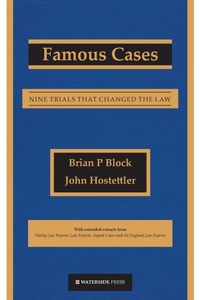
Famous Cases
Nine Trials That Changed the Law
Published on 19. April 2002
Book
Paperback/Softback
136 pages
978-1-872870-34-2 (ISBN)
Description
Every lawyer knows of Woolmington v. Director of Public Prosecutions, the ruling which established the 'Golden thread of English law' whereby the burden of proof lies with the prosecutor in a criminal trial. But who was Woolmington and how many people know that he escaped the death penalty at the eleventh hour, or that he was in fact twice tried for murder? 'Lords give man back his life' as the Western Gazette put it. In the civil law, how and why did a Mrs. Donoghue come to be drinking a bottle of ginger beer containing the remnants of a snail, an event which would determine that 'the categories of negligence are never closed'? And how did the tranquil market town of Wednesbury become shorthand for 'unreasonableness'?
In Famous Cases: Nine Trials that Changed the Law the authors have painstakingly assembled the less well-known background to a selection of leading cases. From Mareva (synonymous with a type of injunction) to Lord Denning's classic ruling in the High Trees House case (the turning point for equitable estoppel) to that of the former Chilean head of state General Pinochet (in which the House of Lords heard the facts a second time) the authors offer a refreshing perspective to whet the appetite of newcomers, students and seasoned practitioners alike.
The book has an authoritative introduction describing 'The Origins of the Common Law' and is enhanced by key extracts from the law reports reproduced courtesy of the Incorporated Council of Law Reporting for England and Wales and the Butterworths Division of Reed Elsevier (UK) Ltd - making it not just an absorbing read but an important work of reference for every legal library and collection.
In Famous Cases: Nine Trials that Changed the Law the authors have painstakingly assembled the less well-known background to a selection of leading cases. From Mareva (synonymous with a type of injunction) to Lord Denning's classic ruling in the High Trees House case (the turning point for equitable estoppel) to that of the former Chilean head of state General Pinochet (in which the House of Lords heard the facts a second time) the authors offer a refreshing perspective to whet the appetite of newcomers, students and seasoned practitioners alike.
The book has an authoritative introduction describing 'The Origins of the Common Law' and is enhanced by key extracts from the law reports reproduced courtesy of the Incorporated Council of Law Reporting for England and Wales and the Butterworths Division of Reed Elsevier (UK) Ltd - making it not just an absorbing read but an important work of reference for every legal library and collection.
Reviews / Votes
'An excellent book'-- Justice of the Peace.More details
Language
English
Place of publication
Winchester
United Kingdom
Target group
College/higher education
Professional and scholarly
Dimensions
Height: 234 mm
Width: 156 mm
Thickness: 8 mm
Weight
219 gr
ISBN-13
978-1-872870-34-2 (9781872870342)
Copyright in bibliographic data and cover images is held by Nielsen Book Services Limited or by the publishers or by their respective licensors: all rights reserved.
Schweitzer Classification
Other editions
Additional editions
E-Book
04/2002
1st Edition
Waterside Press
€27.99
Available for download
Persons
Brian P Block and John Hostettler have written many books and articles on facets of law, lawyers, politics and social history. This is their third book as co-authors.
Content
Part I: Introduction - 1: Origin And Growth Of The Common Law; Part II: Criminal Trials - 2: George Joseph Smith And The Brides In The Bath"; 3: Woolmington's Case; 4: Gypsy Jim Smith; Part III: Civil Cases - 5: Donoghue v. Stevenson; 6: Lord Denning's "High Trees" Case; 7: Rookes v. Barnard; 8: The Mareva Injunction; 9: Wednesbury Unreasonableness; Part IV: International Law - 10:The Trials Of Augusto Pinochet. Index.