

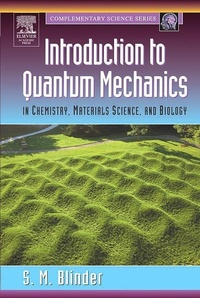
Introduction to Quantum Mechanics
in Chemistry, Materials Science, and Biology
Published on 1. July 2004
Book
Paperback/Softback
319 pages
978-0-12-106051-0 (ISBN)
Description
Introduction to Quantum Mechanics provides a lucid, up-to-date introduction to the principles of quantum mechanics at the level of undergraduates and first-year graduate students in chemistry, materials science, biology and related fields. It shows how the fundamental concepts of quantum theory arose from classic experiments in physics and chemistry, and presents the quantum-mechanical foundations of modern techniques including molecular spectroscopy, lasers and NMR.
Blinder also discusses recent conceptual developments in quantum theory, including Schroedinger's Cat, the Einstein-Podolsky-Rosen experiment, Bell's theorem and quantum computing.
Blinder also discusses recent conceptual developments in quantum theory, including Schroedinger's Cat, the Einstein-Podolsky-Rosen experiment, Bell's theorem and quantum computing.
Reviews / Votes
"Professor Blinder is highly respected and is confirmed by his production of a very good book... Blinder's book has a freshness, a modern approach and is very readable." --Neil R. Kestner, Louisiana State University"I like the book very much. It is clearly written, in a style that should be appealing to students. The figures are especially good, and well chosen to illustrate important concepts that are often discussed without illustration...I found the explanations in the main text to be excellent...I would strongly recommend the book ." --Doug Doren, University of Delaware
"...This is an excellent book to use to introduce Quantum Mechanics to the desired audience...The organisation and style of the book are such that a student would find it easy to read and follow the physical, chemical and mathematical principles under discussion." --Jim McTavish, Liverpool John Moores University
"Introduction to Quantum Mechanics is probably suited as a graduate text for students outside chemistry who need to understand quantum mechanics without undertaking a full year of physical chemistry. In addition to mastering the mechanics, lucky readers of this book will explore the fascinating philosophical and metaphysical implications launched into popular culture the word, quantum." --Kevin. M. Dunn, Hampden-Sydney College, VA, USA, JOURNAL OF CHEMICAL EDUCATION, Vol. 82, No. 3, 2005
More details
Language
English
Place of publication
San Diego
United States
Publishing group
Elsevier Science Publishing Co Inc
Target group
Professional and scholarly
Appropriate introduction to Quantum Mechanics for students in Physical Chemistry, Materials Science, Engineering, and biological sciences. Will be of interest to students, faculty, and lay readers who want a concise but correct discussion of the general concepts of QM.
Product notice
Paperback (trade)
Unsewn / adhesive bound
Dimensions
Height: 229 mm
Width: 161 mm
Thickness: 14 mm
Weight
603 gr
ISBN-13
978-0-12-106051-0 (9780121060510)
Copyright in bibliographic data and cover images is held by Nielsen Book Services Limited or by the publishers or by their respective licensors: all rights reserved.
Schweitzer Classification
Other editions
New editions

S.M. Blinder
Introduction to Quantum Mechanics
Book
10/2020
2nd Edition
Academic Press
€203.50
Shipment within 15-20 days
Additional editions
E-Book
12/2012
1st Edition
Academic Press
€37.99
Available for download
Person
Professor Blinder is Professor Emeritus of Chemistry and Physics at the University of Michigan, Ann Arbor and a senior scientist with Wolfram Research Inc., Champaign, IL.. After receiving his A.B. in Physics and Chemistry from Cornell University, he went on to receive an A. M in Physics, and a Ph. D. in Chemical Physics from Harvard University under Professors W. E. Moffitt and J. H. Van Vleck.
He has held positions at Johns Hopkins University, Carnegie-Mellon University, Harvard University, University College London, Centre de Mechanique Ondulatoire Appliquee in Paris, the Mathematical Institute in Oxford, and the University of Michigan.
Prof Blinder has won multiple awards for his work, published 4 books, and over 100 journal articles. His research interests include Theoretical Chemistry, Mathematical Physics, applications of quantum mechanics to atomic and molecular structure, theory and applications of Coulomb Propagators, structure and self-energy of the electron, supersymmetric quantum field theory, connections between general relativity and quantum mechanics.
He has held positions at Johns Hopkins University, Carnegie-Mellon University, Harvard University, University College London, Centre de Mechanique Ondulatoire Appliquee in Paris, the Mathematical Institute in Oxford, and the University of Michigan.
Prof Blinder has won multiple awards for his work, published 4 books, and over 100 journal articles. His research interests include Theoretical Chemistry, Mathematical Physics, applications of quantum mechanics to atomic and molecular structure, theory and applications of Coulomb Propagators, structure and self-energy of the electron, supersymmetric quantum field theory, connections between general relativity and quantum mechanics.
Content
Preface
1. Atoms and Photons
2. Waves and Particles
3. Simple Systems
4. Principles of Quantum Mechanics
5. Harmonic Oscillator
6. Angular Momentum
7. Hydrogen Atom
8. Helium Atom
9. Atomic Structure
10. The Chemical Bond
11. Diatomic Molecule Orbitals
12. Polyatomic Molecules
13. Molecular Symmetry
14. Molecular Spectroscopy
15. Nuclear Magnetic Resonance
16. Wonders of the Quantum World
Suggested References
Answers to Exercises
1. Atoms and Photons
2. Waves and Particles
3. Simple Systems
4. Principles of Quantum Mechanics
5. Harmonic Oscillator
6. Angular Momentum
7. Hydrogen Atom
8. Helium Atom
9. Atomic Structure
10. The Chemical Bond
11. Diatomic Molecule Orbitals
12. Polyatomic Molecules
13. Molecular Symmetry
14. Molecular Spectroscopy
15. Nuclear Magnetic Resonance
16. Wonders of the Quantum World
Suggested References
Answers to Exercises