

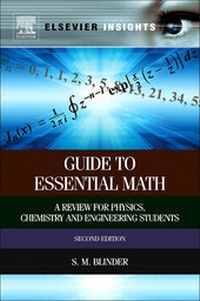
Guide to Essential Math
A Review for Physics, Chemistry and Engineering Students
2nd Edition
Published on 1. February 2013
Book
Hardback
320 pages
978-0-12-407163-6 (ISBN)
Description
This book reminds students in junior, senior and graduate level courses in physics, chemistry and engineering of the math they may have forgotten (or learned imperfectly) that is needed to succeed in science courses. The focus is on math actually used in physics, chemistry, and engineering, and the approach to mathematics begins with 12 examples of increasing complexity, designed to hone the student's ability to think in mathematical terms and to apply quantitative methods to scientific problems. Detailed illustrations and links to reference material online help further comprehension. The second edition features new problems and illustrations and features expanded chapters on matrix algebra and differential equations.
Reviews / Votes
"Blinder throws a life saver to upper-level and early graduate students of physics, chemistry, and engineering who passed the prerequisite freshman and sophomore mathematics courses but are now discovering that they did not really learn very much. All the information is still in their heads, he says, it just needs to be found, dusted off, and loosened up with some exercise."--Reference & Research Book News, October 2013More details
Edition
2nd edition
Language
English
Place of publication
United States
Target group
College/higher education
Upper-level undergraduates and graduate students in physics, chemistry and engineering
Dimensions
Height: 229 mm
Width: 152 mm
Weight
540 gr
ISBN-13
978-0-12-407163-6 (9780124071636)
Copyright in bibliographic data and cover images is held by Nielsen Book Services Limited or by the publishers or by their respective licensors: all rights reserved.
Schweitzer Classification
Other editions
Additional editions
E-Book
02/2013
2nd Edition
Elsevier
€38.95
Available for download
Book
02/2013
2nd Edition
Elsevier
€46.00
Shipment within 15-20 days
Previous edition
Book
06/2008
Academic Press
€47.11
Article exhausted; check for reprint
Person
Professor Blinder is Professor Emeritus of Chemistry and Physics at the University of Michigan, Ann Arbor and a senior scientist with Wolfram Research Inc., Champaign, IL.. After receiving his A.B. in Physics and Chemistry from Cornell University, he went on to receive an A. M in Physics, and a Ph. D. in Chemical Physics from Harvard University under Professors W. E. Moffitt and J. H. Van Vleck.
He has held positions at Johns Hopkins University, Carnegie-Mellon University, Harvard University, University College London, Centre de Mechanique Ondulatoire Appliquee in Paris, the Mathematical Institute in Oxford, and the University of Michigan.
Prof Blinder has won multiple awards for his work, published 4 books, and over 100 journal articles. His research interests include Theoretical Chemistry, Mathematical Physics, applications of quantum mechanics to atomic and molecular structure, theory and applications of Coulomb Propagators, structure and self-energy of the electron, supersymmetric quantum field theory, connections between general relativity and quantum mechanics.
He has held positions at Johns Hopkins University, Carnegie-Mellon University, Harvard University, University College London, Centre de Mechanique Ondulatoire Appliquee in Paris, the Mathematical Institute in Oxford, and the University of Michigan.
Prof Blinder has won multiple awards for his work, published 4 books, and over 100 journal articles. His research interests include Theoretical Chemistry, Mathematical Physics, applications of quantum mechanics to atomic and molecular structure, theory and applications of Coulomb Propagators, structure and self-energy of the electron, supersymmetric quantum field theory, connections between general relativity and quantum mechanics.
Content
1 Mathematical Thinking 2. Numbers3 Algebra 4 Trigonometry5 Analytic Geometry 6 Calculus 7 Series and Integrals 8 Differential Equations 9 Matrix Algebra10 Multivariable Calculus 11 Vector Analysis 12 Special Functions 13 Complex Variables