

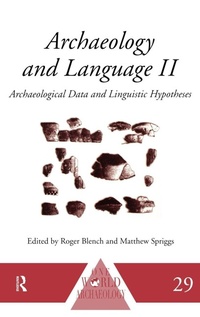
Archaeology and Language II
Archaeological Data and Linguistic Hypotheses
Published on 3. December 1998
Book
Hardback
452 pages
978-0-415-11761-6 (ISBN)
Description
Using language to date the origin and spread of food production, Archaeology and Language II represents groundbreaking work in synthesizing two disciplines that are now seen as interlinked: linguistics and archaeology. This volume is the second part of a three-part survey of innovative results emerging from their combination.
Archaeology and historical linguistics have largely pursued separate tracks until recently, although their goals can be very similar. While there is a new awareness that these disciplines can be used to complement one another, both rigorous methodological awareness and detailed case-studies are still lacking in the literature. This three-part survey is the first study to address this.
Archaeology and Language II examines in some detail how archaeological data can be interpreted through linguistic hypotheses. This collection demonstrates the possibility that, where archaeological sequences are reasonably well-known, they might be tied into evidence of language diversification and thus produce absolute chronologies. Where there is evidence for migrations and expansions these can be explored through both disciplines to produce a richer interpretation of prehistory. An important part of this is the origin and spread of food production which can be modelled through the spread of both plants and words for them.
Archaeology and Language II will be of interest to researchers in linguistics, archaeologists and anthropologists.
Archaeology and historical linguistics have largely pursued separate tracks until recently, although their goals can be very similar. While there is a new awareness that these disciplines can be used to complement one another, both rigorous methodological awareness and detailed case-studies are still lacking in the literature. This three-part survey is the first study to address this.
Archaeology and Language II examines in some detail how archaeological data can be interpreted through linguistic hypotheses. This collection demonstrates the possibility that, where archaeological sequences are reasonably well-known, they might be tied into evidence of language diversification and thus produce absolute chronologies. Where there is evidence for migrations and expansions these can be explored through both disciplines to produce a richer interpretation of prehistory. An important part of this is the origin and spread of food production which can be modelled through the spread of both plants and words for them.
Archaeology and Language II will be of interest to researchers in linguistics, archaeologists and anthropologists.
Reviews / Votes
`A coherent overview of an important topic which has been long ignored and/ or often disparaged.' - Antiquity, September, 1999.'I am very pleased to see this series in press, and I congratulate the editors on their achievement.' - Journal of Linguistics
More details
Series
Language
English
Place of publication
London
United Kingdom
Publishing group
Taylor & Francis Ltd
Target group
College/higher education
Postgraduate
Dimensions
Height: 240 mm
Width: 161 mm
Thickness: 29 mm
Weight
840 gr
ISBN-13
978-0-415-11761-6 (9780415117616)
Copyright in bibliographic data and cover images is held by Nielsen Book Services Limited or by the publishers or by their respective licensors: all rights reserved.
Schweitzer Classification
Other editions
Additional editions
Roger Blench | Matthew Spriggs
Archaeology and Language II
Archaeological Data and Linguistic Hypotheses
Book
08/2014
Routledge
€54.66
The article will not be published
Book
01/2012
1st Edition
Routledge
€77.90
Shipment within 15-20 days
E-Book
09/2003
1st Edition
Routledge
€69.99
Available for download
E-Book
09/2003
1st Edition
Routledge
€69.99
Available for download
Persons
Roger Blench is Research Fellow of the Overseas Development Institute, London. Matthew Spriggs is Professor of Archaeology at the Australian National University, Canberra.
Content
List of figures, List of tables, List of contributors, Preface, General introduction Roger Blench and Matthew Spriggs, Introduction to Volume II Matthew Spriggs and Roger Blench, Part I Correlating archaeological and linguistic sequences, Part II Migration and expansion and their linguistic correlates: Eurasian case studies, Part III Linguistic models in reconstructing subsistence systems, Index