

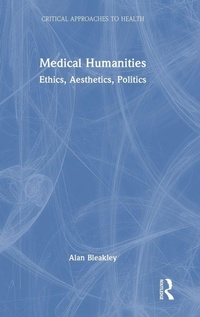
Medical Humanities
Ethics, Aesthetics, Politics
1st Edition
Published on 22. September 2023
Book
Hardback
192 pages
978-1-032-46785-6 (ISBN)
Description
This ground-breaking book sets out a fresh vision for a future medical education by providing a radical reconceptualisation of the purposes of medical humanities through a lens of critical health psychology and liberatory pedagogy. The medical humanities are conceived as translational media through which reductive, instrumental biomedicine can be raised in quality, intensity, and complexity by embracing ethical, aesthetic, political, and transcendental values. This translation occurs through innovative use of metaphor. A note of caution is offered - that the medical humanities too can be instrumental and reductive if not framed well.
Drawing on major theorists such as Michel Foucault and Jacques Ranciere and bringing together insights from diverse but inter-related fields, Bleakley focuses on the "ills" of contemporary biomedicine and medical education, and the need for reconceptualisation, which - it is argued - the translational medical humanities have the potential to accomplish. Current instrumental approaches to medical humanities, embracing communication skills training and narrative-based medicine, have failed to address the chronic symptoms suffered by medicine. These include resort to closed, functional systems thinking rather than embracing dynamic, complex, open, and adaptive systems thinking; lack of democratic habits in medical culture, compromising patient safety and care; the production of insensibility rather than deepening of sensibility in medical education; a lack of attention to ethics, aesthetics, and politics where the instrumental is privileged; and a lack of critical reflexivity in revisioning habitual practices. Through persuasive argument, Bleakley sets out a more radical manifesto for the role the arts and humanities might play in medical/healthcare education and offers a new approach based on curriculum process rather than syllabus content, to recuperate aesthetic sensibilities, discernment, and affect in medicine.
The book will appeal to medical and healthcare educators, medical and health humanities scholars, engaged clinicians, social scientists drawing on critical theory, and arts and humanities practitioners engaging with medical and healthcare themes.
Drawing on major theorists such as Michel Foucault and Jacques Ranciere and bringing together insights from diverse but inter-related fields, Bleakley focuses on the "ills" of contemporary biomedicine and medical education, and the need for reconceptualisation, which - it is argued - the translational medical humanities have the potential to accomplish. Current instrumental approaches to medical humanities, embracing communication skills training and narrative-based medicine, have failed to address the chronic symptoms suffered by medicine. These include resort to closed, functional systems thinking rather than embracing dynamic, complex, open, and adaptive systems thinking; lack of democratic habits in medical culture, compromising patient safety and care; the production of insensibility rather than deepening of sensibility in medical education; a lack of attention to ethics, aesthetics, and politics where the instrumental is privileged; and a lack of critical reflexivity in revisioning habitual practices. Through persuasive argument, Bleakley sets out a more radical manifesto for the role the arts and humanities might play in medical/healthcare education and offers a new approach based on curriculum process rather than syllabus content, to recuperate aesthetic sensibilities, discernment, and affect in medicine.
The book will appeal to medical and healthcare educators, medical and health humanities scholars, engaged clinicians, social scientists drawing on critical theory, and arts and humanities practitioners engaging with medical and healthcare themes.
More details
Series
Language
English
Place of publication
London
United Kingdom
Publishing group
Taylor & Francis Ltd
Target group
Professional and scholarly
Professional Practice & Development, Professional Reference, and Professional Training
Illustrations
6 s/w Abbildungen, 2 s/w Photographien bzw. Rasterbilder, 4 s/w Zeichnungen
4 Line drawings, black and white; 2 Halftones, black and white; 6 Illustrations, black and white
Dimensions
Height: 240 mm
Width: 161 mm
Thickness: 16 mm
Weight
487 gr
ISBN-13
978-1-032-46785-6 (9781032467856)
Copyright in bibliographic data and cover images is held by Nielsen Book Services Limited or by the publishers or by their respective licensors: all rights reserved.
Schweitzer Classification
Other editions
Additional editions
E-Book
09/2023
1st Edition
Routledge
€52.99
Available for download
E-Book
09/2023
1st Edition
Routledge
€52.99
Available for download
Book
09/2023
1st Edition
Routledge
€60.00
Shipment within 10-20 days
Person
Dr Alan Bleakley is Emeritus Professor of Medical Education and Medical Humanities at Plymouth University Peninsula Medical School, UK. He is past President of the Association of Medical Humanities.
Content
1. Born in the USA: origin myths of the medical humanities. 2. The medical humanities come of age. 3. Core, compulsory, and assessed: medical humanities innovations at Peninsula Medical School. 4. The medical humanities: a cure for medical education's ailments? 5. The medical humanities offer a psychotherapeutic approach to medicine's ills. 6. A will to complexity. 7. The distribution of the sensible. 8. Understanding "prescription culture" through literature. 9. The narrative turn. 10. Another turn of the screw: as the good ship "poetry" leaves the harbour.