

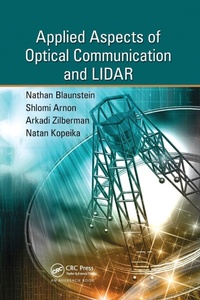
Applied Aspects of Optical Communication and LIDAR
1st Edition
Published on 19. September 2019
Book
Paperback/Softback
280 pages
978-0-367-38457-9 (ISBN)
Description
Exploring the practical aspects of atmospheric optical communication and light detection and ranging (LIDAR), Applied Aspects of Optical Communication and LIDAR details the role of atmospheric structures in propagation phenomena that influence the transmission of optical signals through perturbed atmospheric communication channels. It examines numerous situations in over-the-terrain atmospheric communication channels, including the effects of natural phenomena and the corresponding features (turbulences and hydrometeors) on optical ray propagation.
Bridging the gap between the parameters of optical communication links and signal information data streams, this concise reference addresses line-of-sight (LOS) as well as obstructive non-line-of-sight (NLOS) propagation conditions. It also:
Details the main characteristics of optical communication channels
Introduces the quasi-regular gaseous atmosphere
Describes numerous situations in the atmospheric communication channel
Explains the main characteristics of optical communication channels
Complete with parameters for information data streams, the text also provides time-saving suggestions for determining which optical devices will work best for minimizing the deleterious effects of natural atmospheric phenomena. Whether you're a researcher, an engineer, or student-this book provides you with the practical understanding required to use LIDAR to investigate all forms of atmospheric phenomena and to learn how to accurately predict primary parameters of atmospheric optical channels.
Bridging the gap between the parameters of optical communication links and signal information data streams, this concise reference addresses line-of-sight (LOS) as well as obstructive non-line-of-sight (NLOS) propagation conditions. It also:
Details the main characteristics of optical communication channels
Introduces the quasi-regular gaseous atmosphere
Describes numerous situations in the atmospheric communication channel
Explains the main characteristics of optical communication channels
Complete with parameters for information data streams, the text also provides time-saving suggestions for determining which optical devices will work best for minimizing the deleterious effects of natural atmospheric phenomena. Whether you're a researcher, an engineer, or student-this book provides you with the practical understanding required to use LIDAR to investigate all forms of atmospheric phenomena and to learn how to accurately predict primary parameters of atmospheric optical channels.
More details
Language
English
Place of publication
London
United Kingdom
Publishing group
Taylor & Francis Ltd
Target group
Professional and scholarly
Academic and Professional Practice & Development
Dimensions
Height: 234 mm
Width: 156 mm
Thickness: 15 mm
Weight
433 gr
ISBN-13
978-0-367-38457-9 (9780367384579)
Copyright in bibliographic data and cover images is held by Nielsen Book Services Limited or by the publishers or by their respective licensors: all rights reserved.
Schweitzer Classification
Other editions
Additional editions
Nathan Blaunstein | Shlomi Arnon | Natan Kopeika
Applied Aspects of Optical Communication and LIDAR
E-Book
12/2009
1st Edition
Auerbach
€81.99
Available for download
Nathan Blaunstein | Shlomi Arnon | Natan Kopeika
Applied Aspects of Optical Communication and LIDAR
Book
12/2009
1st Edition
Auerbach
€260.22
Shipment within 15-20 days
Nathan Blaunstein | Shlomi Arnon | Natan Kopeika
Applied Aspects of Optical Communication and LIDAR
E-Book
12/2009
Auerbach
€81.99
Available for download
Persons
Blaunstein, Nathan; Arnon, Shlomi; Kopeika, Natan; Zilberman, Arkadi
Content
Atmosphere: Structure and Processes. Vertical Profiles of Temperature, Pressure, and Number Density. Aerosols. Hydrometeors. Atmospheric Turbulence. Optical Wave Propagation in the AtmosphereRefraction Phenomena. Effects of Aerosols. Aerosol Effects on Optical Wave Propagation. Effects of Hydrometeors. Effects of Atmospheric Turbulence on OpticalPropagation. Measurements of Atmospheric Turbulence. Modeling of Atmospheric Optical Turbulence. Line-of-Sight Bending Caused by Strong. Atmospheric Turbulence. Applied Aspects of LIDAR. Turbulence Profile Measurement with LIDAR. Lidar Research of Passive Scalar Field Fluctuations. Lidar Measurement of Atmospheric Aerosol Parameters. Optical Communication Channels. Main Characteristics. Key Parameters Prediction. Mathematical and Statistical Description. Modulation Methods. Channel and Signal Data Parameters in Atmospheric Optical Communication Links. Irradiance PDF. Key Parameters of Data Stream in Optical. Channels with Fading. Modeling of Key Parameters of the Channel and Information Data. Summary. Abbreviations. Index. Each chapter concludes with a "References" section.