

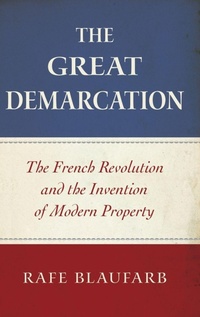
The Great Demarcation
The French Revolution and the Invention of Modern Property
Published on 1. June 2016
Book
Hardback
304 pages
978-0-19-977879-9 (ISBN)
Description
The Great Demarcation explores how the French Revolution transformed the system of property-holding that had existed in France before 1789, thus creating the framework for modern definitions of property and political forms. This book examines the Revolution not from an economic or social perspective, but through the lens of the laws and institutions of property. The Revolution's dramatic legal restructuring aimed at two fundamental goals: removing formal
public power from the sphere of private property, and excising property rights from the realm of the new sovereign, the nation. The revolutionaries accomplished these two aims by abolishing privately-owned forms of public power-such as jurisdictional lordship and venal public office-and by dismantling the
Crown domain to construct a purely sovereign State.
These efforts brought about a Great Demarcation: a radical distinction between property and power from which flowed critical distinctions between the political and the social, state and society, sovereignty and ownership, the public and private. These distinctions destroyed the conceptual basis of the Old Regime, laid the foundation of France's new constitutional order, and crystallized modern ways of thinking about polities and societies. This, Blaufarb claims, was the Revolution's fundamental
act, the stake in the Old Regime's heart, and the basis of all of its other reforms.
Tracing how the French Revolution sought to remake the country's legal and institutional reality, The Great Demarcation shows how the revolutionary transformation of Old Regime property helped to inaugurate political modernity.
public power from the sphere of private property, and excising property rights from the realm of the new sovereign, the nation. The revolutionaries accomplished these two aims by abolishing privately-owned forms of public power-such as jurisdictional lordship and venal public office-and by dismantling the
Crown domain to construct a purely sovereign State.
These efforts brought about a Great Demarcation: a radical distinction between property and power from which flowed critical distinctions between the political and the social, state and society, sovereignty and ownership, the public and private. These distinctions destroyed the conceptual basis of the Old Regime, laid the foundation of France's new constitutional order, and crystallized modern ways of thinking about polities and societies. This, Blaufarb claims, was the Revolution's fundamental
act, the stake in the Old Regime's heart, and the basis of all of its other reforms.
Tracing how the French Revolution sought to remake the country's legal and institutional reality, The Great Demarcation shows how the revolutionary transformation of Old Regime property helped to inaugurate political modernity.
Reviews / Votes
[Rafe Blaufarb's] book provides something more: a history of the united, self-conscious efforts of the lawyer deputies who reworked the historical and legal reasoning of their era to achieve the Great Demarcation of property from power. For this, we are in his debt. This is a major contribution to our understanding of the French Revolution. * Joseph F. Byrnes, French History *More details
Other editions
Additional editions
E-Book
05/2016
1st Edition
OUP eBook
€21.99
Available for download
E-Book
05/2016
1st Edition
OUP eBook
€21.99
Available for download
Person
Rafe Blaufarb is the Ben Weider Eminent Scholar Chair and Director of the Institute on Napoleon and the French Revolution at Florida State University. He is the author of The French Army, 1750-1820: Careers, Talent, Merit, Bonapartists in the Borderlands: French Refugees and Exiles on the Gulf Coast, 1815-1835, and Inhuman TraffickThe International Struggle against the Transatlantic Slave Trade: A Graphic History, among other
titles.
titles.