

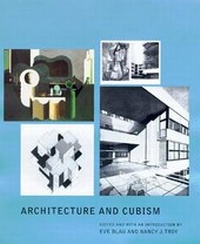
Architecture and Cubism
Published on 21. November 1997
Book
Hardback
364 pages
978-0-262-02422-8 (ISBN)
Description
A fundamental tenet of the historiography of modern architecture holds
that cubism forged a vital link between avant-garde practices in early
twentieth-century painting and architecture. This collection of essays, commissioned
by the Canadian Centre for Architecture, takes a close look at that widely accepted
but little scrutinized belief. In the first historically focused examination of the
issue, the volume returns to the original site of cubist art in pre-World War I
Europe and proceeds to examine the historical, theoretical, and socio-political
relationships between avant-garde practices in painting, architecture, and other
cultural forms, including poetry, landscape, and the decorative arts. The essays
look at works produced in France, Germany, the Netherlands, and Czechoslovakia
during the early decades of the twentieth century.Together, the essays show that
although there were many points of intersection -- historical, metaphorical,
theoretical, and ideological -- between cubism and architecture, there was no
simple, direct link between them. Most often the connections between cubist painting
and modern architecture were construed analogically, by reference to shared formal
qualities such as fragmentation, spatial ambiguity, transparency, and multiplicity;
or to techniques used in other media such as film, poetry, and photomontage. Cubist
space itself remained two-dimensional; with the exception of Le Cobusiers work, it
was never translated into the three dimensions of architecture. Cubism's
significance for architecture also remained two-dimensional -- a method of
representing modern spatial experience through the ordering impulses of
art.Copublished with the Canadian Centre for Architecture/CentreCanadien
d'Architecture
that cubism forged a vital link between avant-garde practices in early
twentieth-century painting and architecture. This collection of essays, commissioned
by the Canadian Centre for Architecture, takes a close look at that widely accepted
but little scrutinized belief. In the first historically focused examination of the
issue, the volume returns to the original site of cubist art in pre-World War I
Europe and proceeds to examine the historical, theoretical, and socio-political
relationships between avant-garde practices in painting, architecture, and other
cultural forms, including poetry, landscape, and the decorative arts. The essays
look at works produced in France, Germany, the Netherlands, and Czechoslovakia
during the early decades of the twentieth century.Together, the essays show that
although there were many points of intersection -- historical, metaphorical,
theoretical, and ideological -- between cubism and architecture, there was no
simple, direct link between them. Most often the connections between cubist painting
and modern architecture were construed analogically, by reference to shared formal
qualities such as fragmentation, spatial ambiguity, transparency, and multiplicity;
or to techniques used in other media such as film, poetry, and photomontage. Cubist
space itself remained two-dimensional; with the exception of Le Cobusiers work, it
was never translated into the three dimensions of architecture. Cubism's
significance for architecture also remained two-dimensional -- a method of
representing modern spatial experience through the ordering impulses of
art.Copublished with the Canadian Centre for Architecture/CentreCanadien
d'Architecture
More details
Language
English
Place of publication
Cambridge, Mass.
United States
Publishing group
MIT Press Ltd
Target group
College/higher education
Professional and scholarly
Illustrations
65 illus.
Dimensions
Height: 254 mm
Width: 203 mm
Thickness: 25 mm
Weight
817 gr
ISBN-13
978-0-262-02422-8 (9780262024228)
Copyright in bibliographic data and cover images is held by Nielsen Book Services Limited or by the publishers or by their respective licensors: all rights reserved.
Schweitzer Classification