

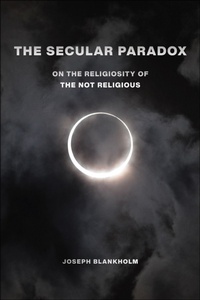
The Secular Paradox
On the Religiosity of the not Religious
Published on 7. June 2022
Book
Paperback/Softback
312 pages
978-1-4798-0950-9 (ISBN)
Description
Choice Outstanding Academic Title 2023
A radically new way of understanding secularism which explains why being secular can seem so strangely religious
For much of America's rapidly growing secular population, religion is an inescapable source of skepticism and discomfort. It shows up in politics and in holidays, but also in common events like weddings and funerals. In The Secular Paradox, Joseph Blankholm argues that, despite their desire to avoid religion, nonbelievers often seem religious because Christianity influences the culture around them so deeply. Relying on several years of ethnographic research among secular activists and organized nonbelievers in the United States, the volume explores how very secular people are ambivalent toward belief, community, ritual, conversion, and tradition. As they try to embrace what they share, secular people encounter, again and again, that they are becoming too religious. And as they reject religion, they feel they have lost too much. Trying to strike the right balance, secular people alternate between the two sides of their ambiguous condition: absolutely not religious and part of a religion-like secular tradition.
Blankholm relies heavily on the voices of women and people of color to understand what it means to live with the secular paradox. The struggles of secular misfits-the people who mis-fit normative secularism in the United States-show that becoming secular means rejecting parts of life that resemble Christianity and embracing a European tradition that emphasizes reason and avoids emotion. Women, people of color, and secular people who have left non-Christian religions work against the limits and contradictions of secularism to create new ways of being secular that are transforming the American religious landscape. They are pioneering the most interesting and important forms of secular "religiosity" in America today.
A radically new way of understanding secularism which explains why being secular can seem so strangely religious
For much of America's rapidly growing secular population, religion is an inescapable source of skepticism and discomfort. It shows up in politics and in holidays, but also in common events like weddings and funerals. In The Secular Paradox, Joseph Blankholm argues that, despite their desire to avoid religion, nonbelievers often seem religious because Christianity influences the culture around them so deeply. Relying on several years of ethnographic research among secular activists and organized nonbelievers in the United States, the volume explores how very secular people are ambivalent toward belief, community, ritual, conversion, and tradition. As they try to embrace what they share, secular people encounter, again and again, that they are becoming too religious. And as they reject religion, they feel they have lost too much. Trying to strike the right balance, secular people alternate between the two sides of their ambiguous condition: absolutely not religious and part of a religion-like secular tradition.
Blankholm relies heavily on the voices of women and people of color to understand what it means to live with the secular paradox. The struggles of secular misfits-the people who mis-fit normative secularism in the United States-show that becoming secular means rejecting parts of life that resemble Christianity and embracing a European tradition that emphasizes reason and avoids emotion. Women, people of color, and secular people who have left non-Christian religions work against the limits and contradictions of secularism to create new ways of being secular that are transforming the American religious landscape. They are pioneering the most interesting and important forms of secular "religiosity" in America today.
Reviews / Votes
"By far the best work done on secular movements and secularism. Blankholm's impressive scope of data and his attention to diversity based on ethnicity, gender, and apostates from non-Christian traditions make this a unique and exceptional contribution to the field." - Darren Sherkat, Southern Illinois University "Masterfully illustrates how the organized secular movement in the US is constantly being negotiated." - Ryan Cragun, The University of Tampa "Simultaneously, an incisive examination of American secularity's paradoxical relationship to `religion,' its constitutive other, and an expansive ethnography of how secular people live with and in that paradox. Blankholm brilliantly attends to secularity not simply as a space of absence-religion's remainder-but as a set of ethical, epistemological, and affective commitments-a tradition. . . . A remarkable book and essential reading for those interested in debates about secularism and religion in the United States and beyond." - Mayanthi Fernando, University of California, Santa Cruz "This work enriches understanding of one of the fastest growing segments of the US population, those with no religious affiliation or identity... [T]his study merits the attention of students of American religious culture at all levels." - C. H. Lippy (emeritus, University of Tennessee at Chattanooga) (CHOICE) "Blankholm's book explores the paradox of secularity that seeks to distance itself from religion but is inevitably shaped and defined by the very thing whose absence it proclaims... as a study of specific American forms of unbelief, the book is interesting, thought-provoking, well-researched - and written in a readable, engaging, and captivating style." (Religious Studies Review) "Pioneering. The Secular Paradox gives voice to a diverse cast of characters who can represent the increasing diversity of secular communities in the twenty-first-century United States and help to dispel views about secularism's inherent whiteness and maleness. A must-read for scholars of American religions... sure to influence future scholarship in the field." (American Religion) "Blankholm's writing is praiseworthy... the author clearly articulates complicated paradoxical positions and clarifies murky terms." (Reading Religion) "Perhaps the most interesting takeaway of Blankholm's book is how White organized American secularism remains. Throughout his travels, the author encountered many secular Black, Hispanic, Muslim, and Native American people, most of whom felt uncomfortable in established secular groups due to the prevalent atmosphere of White middle class assumptions." (Nova Religio)More details
Series
Language
English
Place of publication
New York
United States
Target group
Professional and scholarly
Product notice
Paperback (trade)
Dimensions
Height: 226 mm
Width: 152 mm
Thickness: 26 mm
Weight
431 gr
ISBN-13
978-1-4798-0950-9 (9781479809509)
Copyright in bibliographic data and cover images is held by Nielsen Book Services Limited or by the publishers or by their respective licensors: all rights reserved.
Schweitzer Classification
Other editions
Additional editions
E-Book
06/2022
New York University Press
€25.49
Available for download
Person
Joseph Blankholm is Assistant Professor of Religious Studies at the University of California, Santa Barbara.