

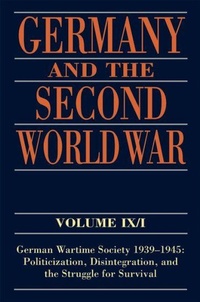
Germany and the Second World War
Volume IX/I: German Wartime Society 1939-1945: Politicization, Disintegration, and the Struggle for Survival
Published on 3. July 2008
Book
Hardback
1080 pages
978-0-19-928277-7 (ISBN)
Description
The Second World War affected the lives and shaped the experience of millions of individuals in Germany - soldiers at the front, women, children and the elderly sheltering in cellars, slave labourers toiling in factories, and concentration-camp prisoners and POWs clearing rubble in the Reich's devastated cities.
Taking a 'history from below' approach, the volume examines how the minds and behaviour of individuals were moulded by the Party as the Reich took the road to Total War. The ever-increasing numbers of German workers conscripted into the Wehrmacht were replaced with forced foreign workers and slave labourers and concentration camp prisoners. The interaction in everyday life between German civilian society and these coerced groups is explored, as is that society's relationship to the Holocaust.
From early 1943, the war on the home front was increasingly dominated by attack from the air. The role of the Party, administration, police, and courts in providing for the vast numbers of those rendered homeless, in bolstering civilian morale with 'miracle revenge weapons' propaganda, and in maintaining order in a society in disintegration is reviewed in detail.
For society in uniform, the war in the east was one of ideology and annihilation, with intensified indoctrination of the troops after Stalingrad. The social profile of this army is analysed through study of a typical infantry division. The volume concludes with an account of the various forms of resistance to Hitler's regime, in society and the military, culminating in the failed attempt on his life in July 1944.
Taking a 'history from below' approach, the volume examines how the minds and behaviour of individuals were moulded by the Party as the Reich took the road to Total War. The ever-increasing numbers of German workers conscripted into the Wehrmacht were replaced with forced foreign workers and slave labourers and concentration camp prisoners. The interaction in everyday life between German civilian society and these coerced groups is explored, as is that society's relationship to the Holocaust.
From early 1943, the war on the home front was increasingly dominated by attack from the air. The role of the Party, administration, police, and courts in providing for the vast numbers of those rendered homeless, in bolstering civilian morale with 'miracle revenge weapons' propaganda, and in maintaining order in a society in disintegration is reviewed in detail.
For society in uniform, the war in the east was one of ideology and annihilation, with intensified indoctrination of the troops after Stalingrad. The social profile of this army is analysed through study of a typical infantry division. The volume concludes with an account of the various forms of resistance to Hitler's regime, in society and the military, culminating in the failed attempt on his life in July 1944.
Reviews / Votes
[Part of] a succession of mighty volumes ... The portrait of German wartime society presented by this book is somber, meticulously documented, cool, reasoned. * The New York Review of Books *More details
Series
Language
English
Place of publication
Oxford
United Kingdom
Product notice
Laminated cover
Illustrations
12 diagrams
Dimensions
Height: 234 mm
Width: 156 mm
Thickness: 56 mm
Weight
1666 gr
ISBN-13
978-0-19-928277-7 (9780199282777)
Copyright in bibliographic data and cover images is held by Nielsen Book Services Limited or by the publishers or by their respective licensors: all rights reserved.
Schweitzer Classification
Other editions
Additional editions
Ralf Blank | Jörg Echternkamp | Karola Fings
Germany and the Second World War
Volume IX/I: German Wartime Society 1939-1945: Politicization, Disintegration, and the Struggle for Survival
E-Book
07/2008
OUP eBook
€74.99
Available for download
Persons
Ralf Blank, M.A. (b. 1962). Studied history and classical and prehistoric archaeology at Cologne and Bochum, as well as applied and theoretical museology at Graz; curator and head of collections and documentation department at the Historischen Centrum Hagen; lecturer in modern and recent history at the Ruhr University at Bochum; preparing a doctoral thesis on the home front and the postwar period in Southern Westphalia (Prof. Norbert Frei);
Dr. Joerg Echternkamp (b. 1963). Studied science of history and Romance studies at the University of Bielefeld, University of Poitiers, and the Johns Hopkins University, Baltimore (USA); on the scientific staff of the Militaergeschichtliches Forschungsamt [Research Institute for Military History], Potsdam;
Dr. Karola Fings (b. 1962). Studied history and German language and literature at the Heinrich Heine University, Duesseldorf; deputy director of the National Socialism Documenta-tion Centre of the city of Cologne; lecturer at University of Cologne;
Dr. Juergen Foerster (b. 1940). Studied English language and literature, philosophy, and history at Nottingham and Cologne (Ph.D. 1974); several visiting professorships, most recently as Miegunyah Distinguished Fellow at the University of Melbourne; adjunct professor at Freiburg University
Col. Winfried Heinemann, Ph.D. (b.1956). Studied history and English language and literature at the Ruhr University, Bochum and at the Department of War Studies, King's College,London; on the scientific staff of the Militaergeschichtliches Forschungsamt [Research Institute for Military History], Potsdam;
Tobias Jersak Ph.D. (b. 1972). 1999-2000 Research assistant to the defence in Irving vs. Lipstadt; 2000-2004 lecturer in history (University of Stuttgart) and church history (University of Muenster); published and edited several books and articles besides educational software on National Socialism, the Holocaust, and Enlightenment thought; moved to St. Petersburg, Russia, in 2005 where he is now working with street-children;
Armin Nolzen M.A. (b. 1968). Studied science of history, German language and literature (modern German literature), social science (political science), and philosophy at the Ruhr University, Bochum; member of the editorial board of Beitraege zur Geschichte des Nationalsozialismus; member of working group on historical peace research; preparing a doctoral thesis on the history of the NSDAP (Prof. Hans Mommsen);
Dr. Christoph A. Rass, (b. 1969). Studied economic and social history, modern history, and information science at the University of the Saarland, Saarbruecken; assistant lecturer in the teaching and research department for economic and social history at the RWTH [Rhineland-Westphalia Institute of Technology] Aachen University;
Dr. Joerg Echternkamp (b. 1963). Studied science of history and Romance studies at the University of Bielefeld, University of Poitiers, and the Johns Hopkins University, Baltimore (USA); on the scientific staff of the Militaergeschichtliches Forschungsamt [Research Institute for Military History], Potsdam;
Dr. Karola Fings (b. 1962). Studied history and German language and literature at the Heinrich Heine University, Duesseldorf; deputy director of the National Socialism Documenta-tion Centre of the city of Cologne; lecturer at University of Cologne;
Dr. Juergen Foerster (b. 1940). Studied English language and literature, philosophy, and history at Nottingham and Cologne (Ph.D. 1974); several visiting professorships, most recently as Miegunyah Distinguished Fellow at the University of Melbourne; adjunct professor at Freiburg University
Col. Winfried Heinemann, Ph.D. (b.1956). Studied history and English language and literature at the Ruhr University, Bochum and at the Department of War Studies, King's College,London; on the scientific staff of the Militaergeschichtliches Forschungsamt [Research Institute for Military History], Potsdam;
Tobias Jersak Ph.D. (b. 1972). 1999-2000 Research assistant to the defence in Irving vs. Lipstadt; 2000-2004 lecturer in history (University of Stuttgart) and church history (University of Muenster); published and edited several books and articles besides educational software on National Socialism, the Holocaust, and Enlightenment thought; moved to St. Petersburg, Russia, in 2005 where he is now working with street-children;
Armin Nolzen M.A. (b. 1968). Studied science of history, German language and literature (modern German literature), social science (political science), and philosophy at the Ruhr University, Bochum; member of the editorial board of Beitraege zur Geschichte des Nationalsozialismus; member of working group on historical peace research; preparing a doctoral thesis on the history of the NSDAP (Prof. Hans Mommsen);
Dr. Christoph A. Rass, (b. 1969). Studied economic and social history, modern history, and information science at the University of the Saarland, Saarbruecken; assistant lecturer in the teaching and research department for economic and social history at the RWTH [Rhineland-Westphalia Institute of Technology] Aachen University;
Author
, Lecturer in modern and recent history at the Ruhr University at Bochum
, Research Institute for Military History, Potsdam
, Lecturer at University of Cologne
, Adjunct professor at Freiburg University
, Research Institute for Military History, Potsdam
, 2000-2004 lecturer in history (University of Stuttgart) and church history (University of Muenster)
, Ruhr University, Bochum
, Aachen University
Translation
Content
A: AT WAR, ABROAD AND AT HOME: THE ESSENTIAL FEATURES OF GERMAN SOCIETY IN THE SECOND WORLD WAR; PART 1: RULE, DESTROY, SURVIVE; B: THE NSDAP, THE WAR, AND GERMAN SOCIETY; C: SLAVES FOR THE 'HOME FRONT'. WAR SOCIETY AND CONCENTRATION CAMPS; D. DECISIONS TO MURDER AND TO LIE. GERMAN WAR SOCIETY AND THE HOLOCAUST; E. WARTIME DAILY LIFE AND THE AIR WAR ON THE HOME FRONT; PART II: THE UNIFORMED SOCIETY; A. IDEOLOGICAL WARFARE IN GERMANY 1919 TO 1945; B. THE SOCIAL PROFILE OF THE GERMAN ARMY'S COMBAT UNITS 1939-1945; C. MILITARY RESISTANCE ACTIVITIES AND THE WAR