

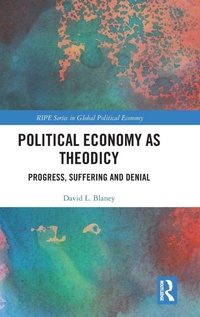
Political Economy as Theodicy
Progress, Suffering and Denial
1st Edition
Published on 5. March 2024
Book
Hardback
224 pages
978-1-032-62573-7 (ISBN)
Description
Political Economy as Theodicy: Progress, Suffering and Denial proposes that political economics operates within a theological symbolic order that dictates modern sociopolitical and economic life as a whole.
This book revisits the work of key figures in the history of political economy and economic thought - primarily Adam Smith, Bernard Mandeville, David Hume, Thomas Malthus, W. Stanley Jevons, Alfred Marshall and John Bates Clark. Theodicy is a constitutive element of an international political economy (IPE) that often disavows moral evil, while it conversely redefines such evil as an actual good within economic life. Beginning with the Enlightenment thinkers and continuing through to the modern neoclasscial economists, this book traces the initial emergence of a natural theological basis for political economic thinking and concludes with a discussion of its application in modern IPE. Relying upon a postcolonial framework, the author seeks to provincialize economics, creating space for alternative modes of being and doing.
This book will appeal to scholars and advanced students of IPE, political theology, international relations and postcolonial studies.
This book revisits the work of key figures in the history of political economy and economic thought - primarily Adam Smith, Bernard Mandeville, David Hume, Thomas Malthus, W. Stanley Jevons, Alfred Marshall and John Bates Clark. Theodicy is a constitutive element of an international political economy (IPE) that often disavows moral evil, while it conversely redefines such evil as an actual good within economic life. Beginning with the Enlightenment thinkers and continuing through to the modern neoclasscial economists, this book traces the initial emergence of a natural theological basis for political economic thinking and concludes with a discussion of its application in modern IPE. Relying upon a postcolonial framework, the author seeks to provincialize economics, creating space for alternative modes of being and doing.
This book will appeal to scholars and advanced students of IPE, political theology, international relations and postcolonial studies.
More details
Series
Language
English
Place of publication
London
United Kingdom
Publishing group
Taylor & Francis Ltd
Target group
College/higher education
Professional and scholarly
Academic, Postgraduate, and Undergraduate Advanced
Dimensions
Height: 240 mm
Width: 161 mm
Thickness: 17 mm
Weight
520 gr
ISBN-13
978-1-032-62573-7 (9781032625737)
Copyright in bibliographic data and cover images is held by Nielsen Book Services Limited or by the publishers or by their respective licensors: all rights reserved.
Schweitzer Classification
Other editions
Additional editions
Book
07/2025
1st Edition
Routledge
€67.30
Shipment within 10-20 days
E-Book
03/2024
1st Edition
Taylor & Francis
€60.99
Available for download
E-Book
03/2024
1st Edition
Taylor & Francis
€60.99
Available for download
Person
David L. Blaney is G. Theodore Mitau Professor of Political Science at Macalester College, USA. He writes on the political and social theory of international relations and global political economy. His three earlier books (with Naeem Inayatullah), International Relations and the Problem of Difference (2004), Savage Economics: Wealth, Poverty and the Temporal Walls of Capitalism (2010) and Within, Against, and Beyond Liberalism: A Critique of Liberal IPE and Global Capitalism (2021), center on culture and political economy and the limits of liberal IPE. With Arlene B. Tickner, he has edited Thinking International Relations Differently (2012) and Claiming the International (2013).
Content
1. Modernity, Theological Metaphysics and Theodicy 2. Harmony/Denial in Smith's Theodicy 3. Spontaneous Order/Domination in Mandeville and Hume 4. Creation's 'Partial Evil' and Malthus' Two Anti-Utopian Messages Interlude: Darwin and Spencer 5. Jevons' Economic Science as Natural Theology 6. Marshall's Theodicy 'Once Removed' 7. Providence, Fairness and Progress in Clark's Marginal Productivity Theory 8. Denial in Neoclassical Economics and IPE 9. Beyond Theodicy?