

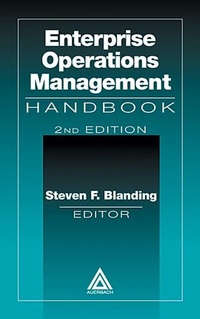
Enterprise Operations Management Handbook, Second Edition
Handbook
2nd Edition
Will be published approx. on 22. October 1999
Book
Hardback
672 pages
978-0-8493-9824-7 (ISBN)
Description
The Enterprise Operations Management Handbook provides the expert advice and guidance of hundreds of leading computing practitioners and consultants. Covering all major areas of enterprise operations management, this edition provides essential information for managing a modern, evolving data center. Topics include business issues, technology issues, and operational issues. This current, practical reference also reviews such critical areas as strategic planning, data center management, data center controls, systems planning, network technology, contingency planning, human resource planning, desktop computing, and future directions. The Enterprise Operations Management Handbook serves as an invaluable tool for designing, building, and maintaining a high-performance, service-oriented data center.
More details
Edition
2nd edition
Language
English
Place of publication
London
United Kingdom
Publishing group
Taylor & Francis Ltd
Target group
Professional and scholarly
Academic and Professional Practice & Development
Illustrations
20 s/w Tabellen
20 Tables, black and white
Dimensions
Height: 234 mm
Width: 156 mm
Weight
1048 gr
ISBN-13
978-0-8493-9824-7 (9780849398247)
Copyright in bibliographic data and cover images is held by Nielsen Book Services Limited or by the publishers or by their respective licensors: all rights reserved.
Schweitzer Classification
Other editions
Additional editions
Steven F. Blanding
Enterprise Operations Management Handbook, Second Edition
E-Book
10/2020
2nd Edition
Auerbach
€81.99
Available for download
Steven F. Blanding
Enterprise Operations Management Handbook, Second Edition
E-Book
10/2020
2nd Edition
Auerbach
€81.99
Available for download
Book
10/2019
2nd Edition
CRC Press
€91.60
Shipment within 15-20 days
Previous edition

Wayne C. Bradley | Auerbach
Handbook of Data Center Management, 1998 edition
Book
08/1997
98th Edition
St Lucie Press
€164.65
Article exhausted; check for reprint
Person
Steven F. Blanding
Content
Introduction Section I IT Management Strategic Planning: Business and Technology Issues. The Corporate Information and Communications Hierarchy. Developing People Skills: A New IT Priority. Professional Consulting: The Analysis Methodology. Pricing Methods Across Linked Networks. Enterprise Modeling for Strategic Support. Section II Data Center Management Reverting to Centralized Data Center Management . Acquiring and Using a UPS System. Providing Quality Information Services to the Customer. Evaluating a Job Scheduler in the Open Systems Arena. Help Desk Technology. Call Center Computer Telephony Integration: A Case Study. Section III Application Infrastructure and Operations Maintaining Data in Mainframe and Network Environments. Managing Data Storage and Distribution. The Data Center Manager's Guide to Networked Imaging Systems. Collaborative Applications. Supporting Legacy Systems. Mingus Client/Server Architecture and Implementation. Section IV Enterprise Network Management TCP/IP Network Management: A Case Study. Trends in Data Communications Services. The Emerging Advantage of xDSL Technology. LAN Printing Techniques. Preparing for Cable Modems. LAN-WAN Interconnection Requirements and Implementation Considerations. Enterprise Deployment: Building an IP PBX Telephony Network. V Desktop Computing A Quick Overview of LINUX. Security and Resource Sharing in an NT Environment. Configuring TCP/IP on a Windows NT Workstation. More Productive User Interfaces. Creating GUIs Users Can Use: Usability Analysis. Building GUIs Users Can Use: Usability Development. Section VI Equipment Asset Management Reducing the Cost of PC Connectivity. Evaluating Equipment: A Methodology for Success. Understanding the Desktop Management Interface. Managing the IT Procurement Process. An IT Asset Management Toolkit. How to Do Better Deals in Leasing. VII Customer Support Operations Managing the User Interface. Managing End-User Development. Helping Users Help Themselves.