

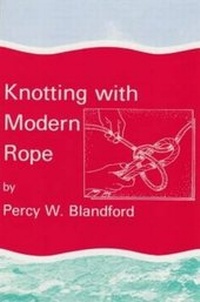
Knotting with Modern Rope
Published in February 1995
Book
Hardback
158 pages
978-0-85174-630-2 (ISBN)
Description
Man-made materials have taken over almost completely from the natural fibres which have previously been used to make rope and all sizes of cordage. Although synthetic rope has many advantages, its smoothness and method of construction makes the surface more slippery, so some traditional knots may slip and be unreliable and even dangerous. Drawing on the author's own experience and that of yachtsmen and climbers, for example, this book addresses the practical problems of knotting synthetic ropes and cordage safely and securely. It describes the best knots for particular applications. It includes some well-known knots and a few newly-developed knots especially suitable for synthetic cordage.
The book gives uses and methods of forming knots, with the body of the book divided into chapters: about modern ropes, strength, sizes, tools, terms; joining knots, for all sizes from rope down to thread; loops, with variations on traditional knots and some special forms; attaching knots for joining to poles, rings, stones, with several special-application knots; binding knots for closing bags, tying parcels and pulling things together; quick-release knots that hold until a part is pulled; adjustable knots that allow setting and control as well as gaining advantage when tightening or pulling; some knots that can be tied when the ends of the rope are unavailable; knots to form stoppers at the end of a rope; and some basic decorative knotting, for which synthetic materials are far better than traditional cords.
The book gives uses and methods of forming knots, with the body of the book divided into chapters: about modern ropes, strength, sizes, tools, terms; joining knots, for all sizes from rope down to thread; loops, with variations on traditional knots and some special forms; attaching knots for joining to poles, rings, stones, with several special-application knots; binding knots for closing bags, tying parcels and pulling things together; quick-release knots that hold until a part is pulled; adjustable knots that allow setting and control as well as gaining advantage when tightening or pulling; some knots that can be tied when the ends of the rope are unavailable; knots to form stoppers at the end of a rope; and some basic decorative knotting, for which synthetic materials are far better than traditional cords.
More details
Language
English
Place of publication
Glasgow
United Kingdom
Target group
Professional and scholarly
Illustrations
glossary, index
Dimensions
Height: 213 mm
Width: 147 mm
Thickness: 12 mm
Weight
299 gr
ISBN-13
978-0-85174-630-2 (9780851746302)
Copyright in bibliographic data and cover images is held by Nielsen Book Services Limited or by the publishers or by their respective licensors: all rights reserved.
Schweitzer Classification