

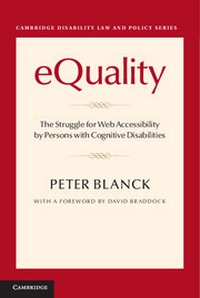
eQuality
The Struggle for Web Accessibility by Persons with Cognitive Disabilities
Published on 31. March 2015
Book
Paperback/Softback
488 pages
978-1-107-68459-1 (ISBN)
Description
Never before have the civil rights of people with disabilities aligned so well with developments in information and communication technology. The center of the technology revolution is the Internet's World Wide Web, which fosters unprecedented opportunities for engagement in democratic society. The Americans with Disabilities Act likewise is helping to ensure equal participation in society by people with disabilities. Globally, the Convention on the Rights of Persons with Disabilities further affirms that persons with disabilities are entitled to the full and equal enjoyment of fundamental personal freedoms. This book is about the lived struggle for disability rights, with a focus on Web equality for people with cognitive disabilities, such as intellectual disabilities, autism, and print-related disabilities. The principles derived from the right to the Web - freedom of speech and individual dignity - are bound to lead toward full and meaningful involvement in society for persons with cognitive and other disabilities.
Reviews / Votes
'We must do our best to invite people with cognitive disabilities to become an integral part of our digital world. It's their right. It's society's gain. It's the right thing to do. So, hooray for eQuality! And hooray for Peter Blanck's high achievement in the publication of this pathbreaking book.' David Braddock, Professor and Director of the Coleman Institute for Cognitive Disabilities, University of Colorado 'The twenty-fifth anniversary of the ADA is a fitting time for Professor Blanck to break wide open new territory in the civil rights struggle of persons with cognitive disabilities. eQuality is a must-read that will prove essential to scholars and practitioners concerned about Web-content equality for all people.' Michael Waterstone, Associate Dean and Professor of Law, Loyola Law School 'Groundbreaking achievement! In eQuality, Peter Blanck sets the stage for future advocacy of equal access to the information society.' Jutta Treviranus, Professor of Design and Director of the Inclusive Design Research Centre, OCAD University 'Jefferson wrote that freedom has to be secured from one generation to the next. The Web allows this and future generations of persons with disabilities opportunities to open up worlds that were previously locked away. eQuality unlocks this potential and secures freedom into the twenty-first century - a virtual civic republic.' Gerard Quinn, Professor of Law and Director of the Centre for Disability Law and Policy, NUI Galway, IrelandMore details
Series
Language
English
Place of publication
Cambridge
United Kingdom
Target group
College/higher education
Professional and scholarly
ISBN-13
978-1-107-68459-1 (9781107684591)
Copyright in bibliographic data and cover images is held by Nielsen Book Services Limited or by the publishers or by their respective licensors: all rights reserved.
Schweitzer Classification
Other editions
Additional editions
E-Book
10/2014
1st Edition
Cambridge University Press
€26.49
Available for download
Book
09/2014
Cambridge University Press
€126.00
Shipment within 15-20 days
Person
Peter Blanck is University Professor at Syracuse University and chairman of the Burton Blatt Institute (BBI). Blanck received a JD from Stanford University, where he was president of the Stanford Law Review, and a PhD in social psychology from Harvard University. He is chairman of the Global Universal Design Commission (GUDC) and president of Raising the Floor (RtF) USA. His books include Genetic Discrimination: Transatlantic Perspectives on the Case for a European Level Legal Response (with Quinn and de Paor, forthcoming); Disability Civil Rights Law and Policy (with Myhill, Siegal and Waterstone, 2014); People with Disabilities: Sidelined or Mainstreamed? (with Schur and Kruse, 2013); Legal Rights of Persons with Disabilities: An Analysis of Federal Law (with Goldstein and Myhill, 2013); and Race, Ethnicity, and Disability: Veterans and Benefits in Post-Civil War America (with Logue, 2010).
Content
Part I. Opening: 1. Introduction: the struggle for Web equality; 2. Web-content equality, the ADA, and participation in society; 3. Web equality and the ADA; Part II. The Advocates' Path: 4. ADA Title III and Web equality: litigation begins; 5. Web equality: second-generation advocacy; 6. Future Web equality advocacy; Part III. Toward Web Equality for People with Cognitive Disabilities: 7. Web-content equality and cognitive disabilities; 8. Web equality in action; 9. Toward Web-content equality; 10. Equality in pocket usability.