

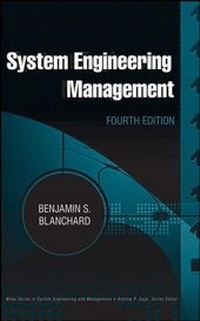
System Engineering Management
4th Edition
Published on 15. August 2008
Book
Hardback
560 pages
978-0-470-16735-9 (ISBN)
Description
Technology/Engineering/General
A top-down, step-by-step, life-cycle approach to systems engineering
In today's environment, there is an ever-increasing need to develop and produce systems that are robust, reliable, high quality, supportable, cost-effective, and responsive to the needs of the customer or user. Reflecting these worldwide trends, System Engineering Management, Fourth Edition introduces readers to the full range of system engineering concepts, tools, and techniques, emphasizing the application of principles and concepts of system engineering and the way these principles aid in the development, utilization, and support of systems.
Viewing systems engineering from both a technical and a management perspective, this fully revised and updated edition extends its coverage to include:
* The changing areas of system requirements
* Increasing system complexities
* Extended system life cycles versus shorter technology cycles
* Higher costs and greater international competition
* The interrelationship of project management and systems engineering as they work together at the project team level
Supported by numerous, real-life case studies, this new edition of the classic resource demonstrates--step by step--a comprehensive, top-down, life-cycle approach that system engineers can follow to reduce costs, streamline the design and development process, improve reliability, and win customers.
More details
Series
Edition
4. Auflage
Language
English
Place of publication
Chichester
United Kingdom
Publishing group
John Wiley and Sons Ltd
Target group
College/higher education
Edition type
Revised edition
Illustrations
Illustrations, maps
Dimensions
Height: 23.6 cm
Width: 16.4 cm
Thickness: 3.3 cm
Weight
911 gr
ISBN-13
978-0-470-16735-9 (9780470167359)
Schweitzer Classification
Other editions
New editions
Benjamin S. Blanchard | John E. Blyler
System Engineering Management
Book
04/2016
5th Edition
Wiley
€155.50
Shipment within 15-20 days
Previous edition
Benjamin S. Blanchard
System Engineering Management
Book
08/2003
3rd Edition
Wiley
€99.90
Article exhausted; check for reprint
Person
Benjamin S. Blanchard is Professor Emeritus in the Department of Industrial and Systems Engineering, Virginia Polytechnic Institute and State University, Blacksburg, Virginia. Professor Blanchard is a Fellow of the International Council on Systems Engineering (INCOSE). In 2000, he was awarded INCOSE's Pioneer Award for his contributions to the field as an "esteemed practitioner, teacher, and advocate of systems engineering."
Content
Foreword.
Preface.
1. Introduction to System Engineering.
1.1 Definition of a System.
1.2 The Current Environment: Some Challenges.
1.3 The Need for System Engineering.
1.4 Related Terms and Definitions.
1.5 System Engineering Management.
1.6 Summary.
2. The System Engineering Process.
2.1 Definition of the Problem (Current Deficiency).
2.2 System Requirements (Needs Analysis).
2.3 System Feasibility Analysis.
2.4 System Operational Requirements.
2.5 The Logistics and Maintenance Support Concept.
2.6 Identification and Prioritization of Technical Performance Measures (TPMs).
2.7 Functional Analysis.
2.8 Requirements Allocation.
2.9 System Synthesis, Analysis, and Design Optimization.
2.10 Design Integration.
2.11 System Test and Evaluation.
2.12 Production and/or Construction.
2.13 System Operational Use and Sustaining Support.
2.14 System Retirement and Material Recycling/Disposal.
2.15 Summary.
3. System Design Requirements.
3.1 Development of Design Requirements and Design-To Criteria.
3.2 Development of Specifications.
3.3 The Integration of System Design Activities.
3.4 Selected Design Engineering Disciplines.
3.5 SOS Integration and Interoperability Requirements.
3.6 Summary.
4. Engineering Design Methods and Tools.
4.1 Conventional Design Practices.
4.2 Analytical Methods.
4.3 Information Technology, the Internet, and Emerging Technologies.
4.4 Current Design Technologies and Tools.
4.5 Computer-Aided Design (CAD).
4.6 Computer-Aided Manufacturing (CAM).
4.7 Computer-Aided Support (CAS).
4.8 Summary.
5. Design Review and Evaluation.
5.1 Design Review and Evaluation Requirements.
5.2 Informal Day-to-Day Review and Evaluation.
5.3 Formal Design Reviews.
5.4 The Design Change and System Modification Process.
5.5 Summary.
6. System Engineering Program Planning.
6.0 Systems Engineering Program Requirements.
6.2 System Engineering Management Plan (SEMP).
6.3 Determination of Outsourcing Requirements.
6.4 Integration of Design Specialty Plans.
6.5 Interfaces with Other Program Activities.
6.6 Management Methods/Tools.
6.7 Risk Management Plan.
6.8 Global Applications/Relationships.
6.9 Summary.
7. Organization for System Engineering.
7.1 Developing the Organizational Structure.
7.2 Customer, Producer, and Supplier Relationships.
7.3 Customer Organization and Functions.
7.4 Producer Organization and Functions (The Contractor).
7.5 Supplier Organization and Functions.
7.6 Human Resource Requirements.
7.7 Summary.
8. System Engineering Program Evaluation.
8.1 Evaluation Requirements.
8.2 Benchmarking.
8.3 Evaluation of the System Engineering Organization.
8.4 Program Reporting, Feedback, and Control.
8.5 Summary.
Appendix A: Functional Analysis (Case-Study Examples.
Appendix B: Life-Cycle Cost-Analysis Process.
Appendix C: Selected Case Studies (Seven Examples).
Appendix D: Design Review Checklist.
Appendix E: Supplier Evaluation Checklist.
Appendix F: Selected Bibliography.
Index.