

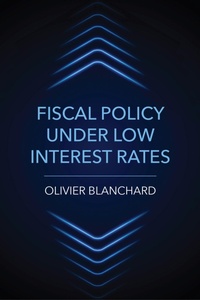
Fiscal Policy under Low Interest Rates
Published on 10. January 2023
Book
Paperback/Softback
192 pages
978-0-262-54487-0 (ISBN)
Description
Rethinking fiscal and monetary policy in an economic environment of high debt and low interest rates.
Policy makers in advanced economies find themselves in an unusual fiscal environment: debt ratios are historically high, and—once the fight against inflation is won—real interest rates will likely be very low again. This combination calls for a rethinking of the role of fiscal and monetary policy—and this is just what Olivier Blanchard proposes in Fiscal Policy under Low Interest Rates.
There is a wide set of opinions about the direction that fiscal policy should take. Some, pointing to the high debt levels, make debt reduction an absolute priority. Others, pointing to the low interest rates, are less worried; they suggest that there is still fiscal space, and, if justified, further increases in debt should not be ruled out. Blanchard argues that low interest rates decrease not only the fiscal costs of debt but also the welfare costs of debt. At the same time, he shows how low rates decrease the room to maneuver in monetary policy—and thus increase the benefits of using fiscal policy, including deficits and debt, for macroeconomic stabilization. In short, low rates imply lower costs and higher benefits of debt.
Having sketched what optimal policy looks like, Blanchard considers three examples of fiscal policy in action: fiscal consolidation in the wake of the Global Financial Crisis, the large increase in debt in Japan, and the current US fiscal and monetary policy mix. His conclusions hold practical implications for economic and fiscal policy makers, bankers, and politicians around the world.
Policy makers in advanced economies find themselves in an unusual fiscal environment: debt ratios are historically high, and—once the fight against inflation is won—real interest rates will likely be very low again. This combination calls for a rethinking of the role of fiscal and monetary policy—and this is just what Olivier Blanchard proposes in Fiscal Policy under Low Interest Rates.
There is a wide set of opinions about the direction that fiscal policy should take. Some, pointing to the high debt levels, make debt reduction an absolute priority. Others, pointing to the low interest rates, are less worried; they suggest that there is still fiscal space, and, if justified, further increases in debt should not be ruled out. Blanchard argues that low interest rates decrease not only the fiscal costs of debt but also the welfare costs of debt. At the same time, he shows how low rates decrease the room to maneuver in monetary policy—and thus increase the benefits of using fiscal policy, including deficits and debt, for macroeconomic stabilization. In short, low rates imply lower costs and higher benefits of debt.
Having sketched what optimal policy looks like, Blanchard considers three examples of fiscal policy in action: fiscal consolidation in the wake of the Global Financial Crisis, the large increase in debt in Japan, and the current US fiscal and monetary policy mix. His conclusions hold practical implications for economic and fiscal policy makers, bankers, and politicians around the world.
More details
Language
English
Place of publication
Cambridge (Massachusetts)
United States
Publishing group
MIT Press Ltd
Product notice
Paperback (trade)
Illustrations
20 B&W ILLUS.
Dimensions
Height: 150 mm
Width: 227 mm
Thickness: 12 mm
Weight
240 gr
ISBN-13
978-0-262-54487-0 (9780262544870)
Copyright in bibliographic data and cover images is held by Nielsen Book Services Limited or by the publishers or by their respective licensors: all rights reserved.
Schweitzer Classification
Other editions
Additional editions
Olivier Blanchard
Fiscal Policy under Low Interest Rates
E-Book
01/2023
MIT Press
€38.99
Available for download
Person
Olivier Blanchard
Content
List of Figures ix
Preface xi
1 Introduction 1
2 Preliminaries 13
3 The Evolution of Interest Rates, Past and Future 27
4 Debt Sustainability 49
5 Welfare Costs and Benefits of Debt and Deficits 89
6 Fiscal Policy in Action 117
7 Summary and Open Issues 139
Bibliography 145
Index 153
Preface xi
1 Introduction 1
2 Preliminaries 13
3 The Evolution of Interest Rates, Past and Future 27
4 Debt Sustainability 49
5 Welfare Costs and Benefits of Debt and Deficits 89
6 Fiscal Policy in Action 117
7 Summary and Open Issues 139
Bibliography 145
Index 153