

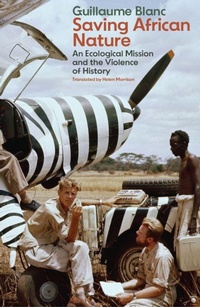
Saving African Nature
An Ecological Mission and the Violence of History
1st Edition
Published on 29. May 2026
Book
Paperback/Softback
304 pages
978-1-5095-6869-7 (ISBN)
Description
During the colonization of Africa, European colonists set about creating game reserves in Africa, convinced that they would find in Africa a nature that no longer existed in Europe. After independence, and with the help of UNESCO and the WWF, African leaders continued to 'protect' the same nature, a nature that the whole world wanted to be pristine, wild and without humans - a timeless Garden of Eden. The consequences of this story are well known: millions of Africans were expelled from the land on which they had lived for generations.
But how did this happen? Who organized this continuity between the colonial era and the era of independence? Guillaume Blanc answers these questions by immersing himself at the heart of a strange global ecological mission, launched in 1961: the 'African Special Project'. He tells the story of this project by bringing to life four worlds: the world of gentleman experts who saw Africa as the world's last natural refuge; the world of East African colonists who were retraining as international experts; the world of African leaders who sought to control their peoples while satisfying the demands of their Western partners; and finally, the world of local farmers and their families living on the land who were forced to adapt or abandon their homes. These men do not speak of the same nature, but step by step, their worlds draw closer together until they meet - and this is where violence erupts.
This impressive book lays bare the violence inherent in the creation of African game reserves and national parks and documents a hidden dimension of colonialism and its legacies.
But how did this happen? Who organized this continuity between the colonial era and the era of independence? Guillaume Blanc answers these questions by immersing himself at the heart of a strange global ecological mission, launched in 1961: the 'African Special Project'. He tells the story of this project by bringing to life four worlds: the world of gentleman experts who saw Africa as the world's last natural refuge; the world of East African colonists who were retraining as international experts; the world of African leaders who sought to control their peoples while satisfying the demands of their Western partners; and finally, the world of local farmers and their families living on the land who were forced to adapt or abandon their homes. These men do not speak of the same nature, but step by step, their worlds draw closer together until they meet - and this is where violence erupts.
This impressive book lays bare the violence inherent in the creation of African game reserves and national parks and documents a hidden dimension of colonialism and its legacies.
Reviews / Votes
"Using diverse archival sources and offering rare attention to overlooked voices, Saving African Nature traces how experts, states, and rural communities shaped conservation in East Africa. It provides a powerful, multi-pronged analysis of the enduring power imbalances behind the region's purportedly pristine places."Raf de Bont, Maastritcht University
"In Saving African Nature, Blanc exhaustively records the elitism, Malthusianism, and control that underlie the conservation mission in Africa. In stunning detail, he reveals the roots of this persistent violence in the unshakable period of its earliest development. The research is meticulous, the storytelling, artful, and the conclusions, profound and disturbing."
Paul Robbins, University of Wisconsin-Madison
"Guillaume Blanc offers a comprehensive micro-history of African environmentalism, giving a voice to each of the actors involved... In this he succeeds: his approach provides a better understanding of the politics of nature in Africa and helps us to make sense of what this postcolonial moment is all about."
L'Histoire
"Guillaume Blanc shows how African nature has been and remains the subject of a myth, that of a universal and timeless Eden - a myth that has been reinforced by colonization, expulsion and exclusion."
Ballast
More details
Language
English
Place of publication
Oxford
United Kingdom
Target group
College/higher education
Professional and scholarly
Dimensions
Height: 152 mm
Width: 229 mm
Thickness: 25 mm
Weight
454 gr
ISBN-13
978-1-5095-6869-7 (9781509568697)
Copyright in bibliographic data and cover images is held by Nielsen Book Services Limited or by the publishers or by their respective licensors: all rights reserved.
Schweitzer Classification
Other editions
Additional editions
Book
05/2026
1st Edition
Polity Press
€65.00
Shipment within 15-20 days
Persons
Guillaume Blanc is Professor in Contemporary History at Sciences Po Bordeaux.
Content
Introduction. Violence in a natural world: from why to how
In the light of the present
Seizing the moment
Making choices
A gallery of institutions
A gallery of actors
Chapter 1. Protecting Africa from the Africans. The world of the expert gentlemen
Arusha 1961. Changing everything in order to keep everything the same
From imperialism to internationalism. History
The rise of a conservationist 'International'
How to conserve: globalize on the one hand, Africanize on the other
Protect the planet, take action in Africa
The experts' (a)political quest
Faces and people of Africa
Chapter 2. Saving the East-African stronghold. The world of those who stayed
Arusha 1961. Working in a liberated Africa
Being part of the transition to independence. History
The East-African International
In the name of the last stronghold of nature
With the 'Africans', against the 'Africans'
An impossible dream
A nightmare
Chapter 3. Governing Ethiopia. The world-nation of African leaders
Arusha 1961. Protecting nature, playing politics
The natural extraversion of the African State. History
Current status: applicant for aid
Accepting dependence
Ethiopia first
Cursed farenj'
Chapter 4. Living in a National Park
The global village of the anonymous
Arusha 1961, nature for some, a way of life for Others
In search of subalterns. History
Tekelakay, or how to resist
Mengest, the local big man
Seratena, invisible employee
Dehaw: the poor man
Yemiyastekaklew, the resourceful one
Epilogue. A little nature, (far) too much humanity
When the postcolonial moment ended
When the time of an enduring postcolony began
Acknowledgements
Acronyms
Bibliography
Notes
Index
In the light of the present
Seizing the moment
Making choices
A gallery of institutions
A gallery of actors
Chapter 1. Protecting Africa from the Africans. The world of the expert gentlemen
Arusha 1961. Changing everything in order to keep everything the same
From imperialism to internationalism. History
The rise of a conservationist 'International'
How to conserve: globalize on the one hand, Africanize on the other
Protect the planet, take action in Africa
The experts' (a)political quest
Faces and people of Africa
Chapter 2. Saving the East-African stronghold. The world of those who stayed
Arusha 1961. Working in a liberated Africa
Being part of the transition to independence. History
The East-African International
In the name of the last stronghold of nature
With the 'Africans', against the 'Africans'
An impossible dream
A nightmare
Chapter 3. Governing Ethiopia. The world-nation of African leaders
Arusha 1961. Protecting nature, playing politics
The natural extraversion of the African State. History
Current status: applicant for aid
Accepting dependence
Ethiopia first
Cursed farenj'
Chapter 4. Living in a National Park
The global village of the anonymous
Arusha 1961, nature for some, a way of life for Others
In search of subalterns. History
Tekelakay, or how to resist
Mengest, the local big man
Seratena, invisible employee
Dehaw: the poor man
Yemiyastekaklew, the resourceful one
Epilogue. A little nature, (far) too much humanity
When the postcolonial moment ended
When the time of an enduring postcolony began
Acknowledgements
Acronyms
Bibliography
Notes
Index