

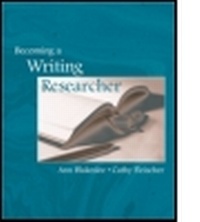
Becoming a Writing Researcher
1st Edition
Published on 12. September 2007
Book
Paperback/Softback
248 pages
978-0-8058-3997-5 (ISBN)
Description
Becoming a Writing Researcher effectively guides students through the stages of conducting qualitative writing research, from the initial step of seeing themselves as researchers, to identifying research questions, selecting appropriate tools, conducting the research, and interpreting and reporting the findings. Authors Ann M. Blakeslee and Cathy Fleischer describe various qualitative methods and provide readers with examples of real-world applications. Exercises and activities, as well as anecdotes from both novice and seasoned researchers, serve to acquaint readers thoroughly with the practice of carrying out research for scholarly or professional purposes.
The textbook introduces students to research methods in a gradual and contextualized manner. Each chapter opens with a discussion of general issues regarding a particular portion of the research process, followed by a consideration of the various physical, conceptual, and strategic tools that allow a beginning researcher to conduct that part of the process. Sections within each chapter also cover:
personal and theoretical perspectives and biases that influence specific stages of the research process
ethical issues associated with phases of the research process
the identity, ethos, and experiences of the researcher.
Becoming a Writing Researcher is an essential text for all novice researchers, and is well suited for use in graduate-level research methods courses in composition and technical communication. It is also ideal for use in other disciplines with strong qualitative methodology research programs, including education.
The textbook introduces students to research methods in a gradual and contextualized manner. Each chapter opens with a discussion of general issues regarding a particular portion of the research process, followed by a consideration of the various physical, conceptual, and strategic tools that allow a beginning researcher to conduct that part of the process. Sections within each chapter also cover:
personal and theoretical perspectives and biases that influence specific stages of the research process
ethical issues associated with phases of the research process
the identity, ethos, and experiences of the researcher.
Becoming a Writing Researcher is an essential text for all novice researchers, and is well suited for use in graduate-level research methods courses in composition and technical communication. It is also ideal for use in other disciplines with strong qualitative methodology research programs, including education.
Reviews / Votes
"Overall, Becoming a writing researcher is a helpful and practical guide for novice researchers. I recommend it to students writing theses and to their advisors." - Technical Communication, Volume 55, Number 3, August 2008More details
Language
English
Place of publication
New York
United States
Publishing group
Taylor & Francis Inc
Target group
College/higher education
Professional and scholarly
Dimensions
Height: 234 mm
Width: 190 mm
Weight
432 gr
ISBN-13
978-0-8058-3997-5 (9780805839975)
Copyright in bibliographic data and cover images is held by Nielsen Book Services Limited or by the publishers or by their respective licensors: all rights reserved.
Schweitzer Classification
Other editions
New editions
Ann Blakeslee | Cathy Fleischer
Becoming a Writing Researcher
Book
07/2019
2nd Edition
Routledge
€72.50
Shipment within 15-20 days
Additional editions
Ann M. Blakeslee | Cathy Fleischer
Becoming a Writing Researcher
E-Book
03/2009
1st Edition
Routledge
€48.29
Available for download
Ann M. Blakeslee | Ann Blakeslee | Cathy Fleischer
Becoming a Writing Researcher
E-Book
03/2009
Routledge
€45.49
Available for download
Ann M. Blakeslee | Ann Blakeslee | Cathy Fleischer
Becoming a Writing Researcher
Book
01/2008
1st Edition
Lawrence Erlbaum Associates Inc
€163.42
Article exhausted; check for reprint
Persons
Content
Contents: Me, A Writing Researcher? What's Your Question? How Do I Find Answers?: Planning Your Qualitative Research Study. How Do I Find Answers?: Carrying Out Your Qualitative Research Study, Part 1-Reading, Observing, and Analyzing Artifacts. How Do I Find Answers? Carrying Out Your Qualitative Research Study, Part II-Interviewing and Using Surveys and Questionnaires. What Do I Do with the Information I Collect?: Analyzing Data. How Do I Present My Research?: Writing Up Your Findings.